Providing local news, info, and tips and tricks for homeowners and those interested in buying or selling real estate in North Idaho or Western Washington.
Also, listen to the Real Estate, Money and Marriage Podcast at KatherineAndDarin.com
Bonus Material: A Free Guide That Helps You Get Sell Ready (18 Home Preparation Tips)


This 5th annual Mac and Cheese festival, hosted by Coeur d’Alene Downtown Association, will celebrate all things cheesy, creamy, and delicious.
The festival will take place in downtown Coeur d'Alene, and it will be the perfect event for foodies of all ages. Be sure to mark the date on your calendar, because this festival is not one to miss!
How do you define a real estate investor? Someone with tons of money and skills, a pick up truck, maybe their own show on HGTV?
Or could it be a regular person you work with, someone in your family, your next door neighbor, a lifelong friend?
Can YOU be a real estate investor?
I’m going to show you how I did it (and how I’m still doing it).
I want you to know that you don’t need a college degree, a six-figure income, a spouse or even a lot of money to get started.
.png)
I’ll give you the quick story since I wrote about it in more detail in an earlier version of this article.
I bought a condo in Mukilteo. I lived in it for 4 years. The value went down for 3 years then started creeping back up. I didn’t really care about the value because I had no plans to sell.

It was what we could afford. A little starter home in Lake Stevens. But it was bigger than the condo and it was comfortable. Move-in ready. We knew it would be a good rental once we saved up enough to buy another home.
We put 20% down. We didn’t have to but we wanted to keep the payment really low for maximum cash flow later on. It was a very low purchase price but still, it was not easy coming up with 20% down. Lots of sacrificing and saving led up to that purchase.
The difference between the condo payment and the rent I got each month was about $150. Not much, but a good start! That helped us afford our new home and it helped us save for the next down payment.

It’s a good time to mention we didn’t qualify for all of these mortgages. We were able to use market rent as income (for the home we planned to move out of and then rent) even though the home we were living in wasn’t rented YET. We had to show a signed lease to our lender before closing in order to get our loan approved and funded.
The difference between the payment and the rent for the one we bought in 2013 was about $400. Oh, and we had raised the condo rent by this point in time. Total monthly rental income was about $600 by this point in time. Enough to help, for sure! Kept on saving for the next home.

Rent from the previous home was about $300 higher than our payment each month. At this point, our total rental income was about $900 per month.
Each time we bought, the home got a little bigger, which worked well for us since our family has grown in this time. We moved into all of them as we bought, so we could get an owner-occupied interest rate and so we didn’t have to put 20% down. When you buy a home and immediately rent it, rather than move into it, you’ll get a higher interest rate and most of the time you’ll be required to put at least 20% down. Living in the homes at first creates some flexibility.
Note: We didn’t sell any of these homes along the way.
We didn’t use the equity in the homes as a down payment for the next.
We just never stopped saving.
Immediately after buying that condo in 2009, I was saving for the next home. Some months it was only $10 added to my savings account and some months I may have gone the wrong direction but I kept a close eye on that savings account balance. It was my down payment for the next home.
In Post Falls, ID. Diversifying a little with this one. And, didn’t move into it. We just had some extra money and wanted to do something smart with it. The rent is about $300 higher than the payment.

Before I had ever met him, my husband bought a couple of homes in Wisconsin. We still own those as well and between all of these homes, our rental income is currently a little over $2000 per month. We can’t live off of that, but it covers a huge chunk of our monthly expenses.

Something else that is worth noting is how much equity we have earned in this amount of time. It’s hundreds of thousands of dollars, which represents options to me.
And the best part of the appreciation is that I’m not even paying these mortgages anymore. My tenants are.
BTW, they are all wonderful. They all pay below-market rent. I treat my tenants well because they enable me to do this. I also encourage them to buy their own homes. It is so satisfying when they do!
Whether you have one rental property, or 7 like me, (or 100+): real estate investments will add to your monthly income, your net worth, and your future opportunities!!
I didn't even touch on tax benefits or principal paydown, but those are two other things that are working for you while you sleep.
Highlighting the key behaviors/mindsets for pulling this off:
What You Can Do Next:
1. Read the original article I wrote 4 years ago on this for more details: https://www.persingergroup.com/blog/be-a-real-estate-investor-too/
2. Contact me with any questions you have about getting started with real estate investing
3. Message us at m.me/persingergroup to get a FREE GUIDE - 8 Simple Money Hacks That Will Help You Get Ahead With Real Estate.
Just type "8" we'll know what you mean and send the guide.
 How much do you really need to save for a down payment?
There's a lot of confusion that exists out there, about how much do you really need.
In fact, when millennials were surveyed and asked, How much money do you need to save for a down payment?
Millennials responded with the average coming back at 32%. Millennials thought that you need to have a down payment of 32%.
But the reality is that people are only putting down 5.3%.
So how can that be?
Where is the disconnect?
When we talk to potential Homebuyers, they typically think they need 20%. That's the number that we usually see from home buyers out there.
But then, to see these numbers think you need a 32% down payment, when on average home buyers are only putting down 5.3%. And look, in our own neighborhood, we've helped a number of buyers buy with zero down.
There's a lot of programs where you can buy with 5%, 3% even 0% down.
So how can this be? Where's the disconnect from this?
Well, if you keep thinking you're going to try to save up for a down payment, whether that's 20% down payment or a 32% down payment...
If you keep trying to save for that, it feels like you're chasing a ball down the hill. The ball is just going to pick up more and more speed and you're never quite catch up.
Here are three things you should think about when it comes to saving that down payment:
Appreciation doesn't mean that you appreciate the value of the money and the value of the home.
It means how the home value goes up.
So let's say you're looking at homes for sale for around $400,000 in our area.
In Snohomish County that is pretty typical, pretty normal, pretty average. And let's say that the home values are going to go up about 7% over the next year.
This means you need to save $28,000 just to keep pace just to buy the same house next year.
You're gonna have to save an additional $28,000. In the next year!
Does that make sense?
So if you're looking at a $400,000 home, it goes up 7% in value. You need to save $28,000 more this year just to keep pace.
A lot of people can't save that type of money, so the question becomes: Can you save that much money, or are you just spinning in your wheels, delaying, getting something that you could get right now?
Inflation is the reason why 20 years ago you could buy a candy bar for 50 cents and a can of Coke for 50 cents, and now it costs a $1.50.
But most people just think the costs of things increase every year.
But the way to think about inflation is the value of your dollar decreases almost every single year. It's not necessarily the cost of things increasing. It's the value of your dollar is decreasing.
So something to consider moving forward with what happened this year. And as the government's pumped in trillions of dollars into the economy: Do you think your dollar is going to be worth more or less over the next few years?
The third reason why it's so hard to save for a down payment is motivation.
We've talked about appreciation, home values going up. It feels like you're chasing a ball down the hill. We've talked about inflation, the value of your dollar is going down every year.
This brings us to motivation.
It's hard to stay motivated with appreciation and inflation going on. So you get to a point where you're we have $10,000, $15,000, $20,000 saved up and now wonder "Is it even worth it?"
I'm saving money. But the home that I wanted to buy last year is now worth $28,000 more. Maybe I should just buy a new car or go on a nice vacation or go out to a nice dinner.

The three reasons why it's so hard to save up for a down payment, and probably why it doesn't actually make sense to try to save up for that 20% or even 32% down payment.
As I said, there's plenty of programs out there where you could get into a home for much, much less down payment.
If this is something that you're interested in and you want help figuring out how much money do you need to save, what's the right down payment for you based upon what you're looking for in your next home visit persingergroup.com/buying.
And another thing I'd ask if this was helpful or you know someone that is struggling with one of these things and they want to buy, share this article with them.
---
Darin Persinger has been a licensed Realtor since 1997, but this wasn't the start of his real estate career. In high school, Darin started a "yard sign" business for the local real estate agents. In the dead of winter in Wisconsin, Darin drove around his Dad's little Dodge Ram truck installing real estate yard signs. He now helps clients buy homes andsell real estate in Snohomish County with his wife Katherine.
On March 25, 1967, Daredevil Evel Knievel did his first televised jump on ABC’s Wide World Of Sports. Riding a Triumph, Evel jumped over 15 cars.
ABC didn’t broadcast the jump live, because they thought he’d crash.
Evel would go on to make seven more appearances on the Wide World of Sports. In 1973, riding a Harley-Davidson, Evel successfully jumped over 50 stacked cars at the Los Angeles Memorial Coliseum. The record wasn’t broken until 2008.
Evel Knievel was famous for making big jumps and clearing large gaps.

But when it comes to buying a home, maybe you shouldn’t try to be a daredevil like Evel. Trying to jump from renting to a dream home.
Start small. Start where you can start.
1. The Three Areas Of Getting Ready To Buy
2. The Importance of Starting Where You Can Start
3. The Three Things That Make A Dream Home
There are three areas you need to be ready in before buying a home.
Many first-time buyers think about getting ready to buy a house as being ready financially. Ex. paying down debt, saving up for a down payment, making sure they can afford the monthly mortgage, having reserves, etc.
Fear of finances
Just over half (56%) of all buyers who don't own a home today but want to say they're not pursuing it because they fear they won't qualify for a loan, according to a survey by LoanDepot.
While 71 percent of all Americans who want to buy a home in the next two years will need financing, 89 percent haven't actually taken any steps to see if they could get a home loan. Specifically, three quarters (74%) of people who want to buy a home but fear they won't qualify for a mortgage admit they haven't taken any steps to qualify.
Many would-be-home-buyers take themselves out of the game before they ever get in the game.
Are you ready psychologically? Are you ready for homeownership?
A lot of energy, focus and time is spent in getting ready financially, but what's interesting is a lot of buyers are ready in that category. But because they're not ready in their heads, they don't even sit down and talk to a mortgage lender.
They talk themselves out of even taking the first step and say to themselves, "I'm not ready because of my finances." or “I have too much debt.”
 7 years ago we were living in a condo.
I had to go up and downstairs to take Pearl the French Bulldog out.
The best she got for “sun” time was on our patio.
I told Katherine that I wanted a yard for Pearl.
She wasn’t going to live much longer and I wanted her to have a yard.
A yard to run around in.
A yard to sunbath in.
A yard to just got outside with the open of a door.
We wanted a few more things in our home, but a yard for Pearl was the #1 driving search criteria.
We found a home.
It had a yard.
And there was not much else about the home we liked.
But we bought it.
And buying that home, allowed us to buy a next home.
And then a next home.
And here is Pearl (still alive) enjoying the sun and a much, much bigger yard.
Some people might think we settled on that first home that had a yard for Pearl.
But we were clear about the benefits we wanted, not just the features and dimensions of the home.
That home not only gave us a yard for Pearl. It was the home we brought our first baby home to.
I 100% get wanting your home to have a garage, and bathroom on the main level, and quartz countertops (that home had none of those things).
But sometimes you gotta start where you can start.
You’re not settling. You’re starting.
Again, we don’t have to do a death-defying jump, like Evel Knievel, from Point A to Point K.
Starting where you can start and use that as a stepping stone to your next home and closer to your dream home.
In 2020, millennials were more likely than other groups to believe that they will live in their dream home at some point in their life (research from Coldwell Banker, 2020):
From experience, they’re also more likely to postpone buying their first home. (The median age for first-time homebuyers is 33.)
So, Millennials are starting later and expecting more.
But according to data from the Federal Reserve indicates the net worth of a homeowner is actually over 40 times greater than that of a renter. A homeowner’s net worth is $254,900 vs a renters $6,270.
We’re told to start investing early. Max out 401k’s and IRA’s. The same principle can easily apply to buying a home.
We have a client and friend named Sam.
Sam did two things:
1. Made homeownership a priority
2. Started where she could start
Sam recently, bought a new construction home for herself and her daughters. She can afford it easily because she had a 50% DOWN PAYMENT for that home.
How?
Sam works in a restaurant. And 7 years ago, she didn’t have a huge down payment, but she said to Katherine, “I’m thinking about buying a condo.”
With a small down payment, she got into that condo. A few years later, she now had paid down the principle, increased her equity and saved up more money. She sold the condo and bought a townhome with a 20% down payment.
That first step and next step allowed her to get to a new construction home with 50% down.
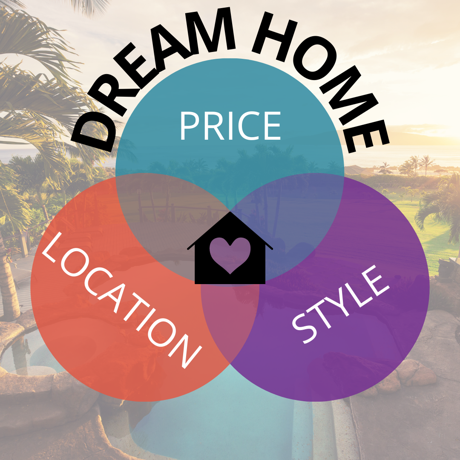 We define a dream home as a home that is the location you want, the style you want, and at a price, you can afford.
Typically you’ll get two out of three.
If you want to be in that great location, to be able to afford it, you probably won’t get the style you want. For example, maybe it’s a two-bedroom, dated, condo, instead of a three-bedroom, brand new, single-family home with a yard.
Or maybe you want a certain style of home. You want a modern farmhouse style on 5 acres. And because of the price, you can only afford up to $X. You’ll probably discover that the location won’t be as ideal as you’d like. You’ll be further out of town, or in an area that would not be your first choice.
But if you are lucky enough to able to get all three without sacrifice or compromise... Congrats, you just got your dream home.
The reality is though unless you’re a start-up millionaire, celebrity or professional athlete, your first home probably won’t be your dream home.
But your first home can be a stepping stone to your dream home.
If you're ready to take the first step into learning more about how Persinger Group can help you buy your first home. Check out our proprietary guide, '7 Costly Mistakes Home Buyers Make.'
One of the things that keep people where they are instead of where they want to be is misinformation and myths. Side-step these mistakes and save yourself time, money, frustration and disappointment during your home buying journey.
Instant download by visiting http://costlymistakeshomebuyersmake.com
When you are ready to get your questions answered, let's talk. We have a process that helps you get your money right, find the right home and write the right offer. Over 50+ combined real estate excellence and expertise can show the first steps and the next steps in a quick call.
Pick a time to talk http://smartmovescall.com/

That is what is rumored to be on the legendary San Jose, a sunken Spanish ship.
In 1698, the San Jose was part of the Spanish treasure fleet, a convoy of ships tasked with transporting valuable items from the Spanish Empire back to Spain.
Risky business: Spain and France were involved in the War of the Spanish Succession, a conflict that pitted the two countries against England and that involved attacks on Spanish trade vessels like the San Jose.
The San Jose came under attack and supposedly, with all it’s treasure sunk in 1708. 300 years later, some salvagers believed they had finally found it and identified it. This set off an in court and out of court battle over who discovered it first.
Even though the ship and treasure have been found, it still doesn’t belong to anyone. It’s one thing to find the treasure. It’s another thing to bring the treasure home.
Why Finding A Home Is Easy
Buying The Home Is Harder
How The Right Sequence Helps
.png) Home buyers could start with a Google search, “homes for sale in Lake Stevens” or “new construction in Post Falls” - you’ll find plenty of places to start your home search online.
Home buyers could start with a Google search, “homes for sale in Lake Stevens” or “new construction in Post Falls” - you’ll find plenty of places to start your home search online.
Homebuyers could of course start at PersingerGroup.com - where we have every home for sale in Western Washington and North Idaho - from every real estate broker.
Some home buyers start at Zillow or Realtor.com
Starting the home search online is an obvious and easy way to go.
It’s fun to swipe through the new listings. See what’s available and look at the pictures.
Maybe you even go out on the weekends, get a cup of coffee and pop into some open houses.
Finding a home can be easy and fun.
But that’s just the start…
According to the National Association of Realtors Homebuyer Report, 33% of the time a real estate agent found the home a buyer purchased. So even though you have access to these tools and search yourself, having a Realtor who understands the market and your search criteria is still critical.
It should be noted that Persinger Group finds the property for our buyer clients 2/3’s of the time. Why are we double the normal? Probably because of our system, communication and ability to help our buyer clients communicate to us.
___________
If you’re struggling with finding your home start you can schedule a Smart Moves Call at http://smartmovescall.com/
___________
Once you find the home, you have to buy the home.
This means:
.png) How should you craft an offer to get it accepted?
How should you craft an offer to get it accepted?You don’t want to overpay, but you don’t want to miss out on either.
The offer depends on the market. And every market has multiple markets.
What if your offer is rejected and another buyer gets your home?
What happens if something is found during the inspection? What can you ask for? Does it ever make sense to not do an inspection?
Do you know what to look for in a resale certificate?
Why is earnest money so important?
These questions are just the tip of the iceberg?
"The time you want the map is before you enter the woods." - Brendon Buchard
.png) If you’re trying to buy a home before you’ve pre-approved, you’re putting the cart before the horse.
If you’re trying to buy a home before you’ve pre-approved, you’re putting the cart before the horse.
If you’re trying to find the right home before you’ve found the right real estate agent, you’ll start scrambling and stressing when you do find the right home.
You’ve entered the forest, got lost, and now realize you should have brought a map.
You could try to solve a math problem any way you want, but you’ll probably get the wrong answer.
You could do this math problem left to right…
4 + 2 × 3 = 18 ---> (4 + 2)×3 = 6×3 = 18
...or you could multiply first: 4 + 2 × 3 = 10 ---.> 4 + (2×3) = 4 + 6 = 10
Which answer right?
10 or 18.
Luckily, we know there is a sequence to solving math problems. PEMDAS.
As is with most things, sequence matters.
But we insist on doing things out of order, which causes problems, frustrations, mistakes and getting things wrong.
Start with the right first steps and everything else is easier.
Now, then next.
Today we discussed the difference between finding a home and buying a home. And the importance of taking the right steps in the right order.
Most of our clients, when they’re just curious, start their home search on our website. It has every listing, from every brokerage. It’s updated every 6 minutes. Saves your favorites. And makes it easy to schedule showings online. https://persingergroup.com/buying
And when you're ready to get serious, let’s talk. In a short 15 minute call we can show you how to implement this proven into your home search. Book your call at http://smartmovescall.com

A few years ago, to get into better shape, I decided it was time to start running.
I realized that I would need some help with this process because I had never been a runner before.
Never.
So I went to a local shoe store that specializes in shoes for runners, in fact, marathon running.
The first thing that they did was assess how I walked and how I ran. Then they made a few recommendations for shoes that would fit my stride, my style of running and my weight at that time.
I remember they recommended three specific shoes and one pair was Nike. When I tried on the Nike shoes, they were by far the most comfortable shoes of the three pairs. I said this out loud and the shoe consultant, running consultant, I guess we'll call them said to me that is what Nike does.
Nike is great at that.
Nike specializes in what they call First-Fit.
Nike believes if their shoe is the most comfortable shoe the first time you try it on, you’ll buy their shoe.
When I got home, I Googled this.
Nike First-Fit.
I couldn't find any information about this online.
So I don't know if he's making this up or if this is just a real hush, hush industry secret. But he said, Nike designs their shoes, they're made that way to feel really comfortable when you try them on in the store, that first fit.
And that of course makes sense when you think about it.
Why would you buy a less comfortable shoe… especially when it’s something that is going to be used for sports, running, etc?
When it comes time to sell your home, thinking about First-Fit matters.
We believe First-Fit happens a few times when selling a home.
First Fit is the first impression.
The first impression not just in person, but also online.
This is why we feel staging vacant homes at no additional cost to our clients is so crucial. It doesn't matter. The price point could be a $200,000 condo. Could be a $2 million home. Those first impressions matter, just like the Nike First-Fit matters.
This might be why Nike is one of the most dominant brands in the world.
This is also why we put so much of our own time and our own money into the pictures and the videos of the homes that we are selling. (Check out our 10K Views Guarantee.)
First-Fit.
First impression.
For the majority of home buyers, the first impression is actually online. Before they ever decide to come out and take a look at your home before they schedule that private tour, they're looking at their phone, they're looking at their computer. They're looking online to see if, if that home is a fit for them, they're trying to get a feel for it. They don't want to waste their time looking at a home that doesn't feel right to them. They're basing this feeling completely off of pictures and video they see online.
The last thing that you want when you're trying to sell your home is for a potential home buyer to say no to it before they ever step foot in your home.
And we've made a getting your home ready for sale process to take advantage of this First Fit idea.
When it comes to getting a home sell ready, there are two major, costly mistakes sellers make.
This is why we’ve made getting a home sell ready super easy for our clients.
It’s three steps and you can read about that at the end of this article, but first...
#1 Spending too much money
Many home sellers believe that expensive projects will help them sell their home for the most money.
They start ripping out carpet and installing hardwood floors.
Or they do a complete kitchen remodel.
The reality is in most situations homeowners won't get their money back out on costly remodeling projects.
According to Remodeling Magazine’s 2020 Cost vs. Value Report, depending on the size of the job, you’ll likely recoup 66% to 85% back on a kitchen remodel in the Seattle area.
For example, they show an average of spending $76,000 on a midrange upgrade, but only getting about $50,000 back in resale value.
Not only is that expensive, but it also leads to major mistake number two.
#2 Wasting time
When selling, a homeowner probably has other things going on in their life. Not just the packing and moving, but maybe a new job, a newborn, or something like a death or divorce.
So we believe, why add more stress to an already stressful situation?
We’ve experienced many home sellers tell us that they’ve spent their nights and weekends for the last few months “getting their home ready” before even contacting us.
You don’t have to try to impress us, the real estate advisors.
You bring us in to help you impress the real estate buyers.
After those nights and weekends, many of the wrong projects were done.
It took longer to get on the market than they wanted and they wasted time and money doing projects that didn’t need to be done.
 WHAT’S NEXT?
Three Steps To Getting Selling Ready
1. Visit getsellready.com
You'll be able to get access to our guide that shows you the major steps to take, to get your home sell ready, and also our 47 point checklist to make it easy to know what to do to get your home sell ready.
2. Hop on a quick phone call with us.
The short, quick phone call will give us a better understanding of where you're at, what you're trying to do in the timeline that you're trying to do with it. The small time investment up front saves you a big chunk of time later in the middle of the transaction when things are a little bit more stressful already.
3. Home Walkthru.
This allows us to give sellers suggestions on what to do, what not to do or alternatives. This can save our clients a bunch of time and a bunch of money by helping them focus on the projects that truly matter to get their home sell ready.
Our clients, who are able to save the most money, put the most money in their pocket and have the smoothest home sale are the ones that connect with us weeks - if not months before. They're getting ready to sell their home so we can help them figure out what projects to do, which projects not to do and different ideas.
Darin and Katherine Persinger
Emotional.png)
Financial
Mental (Psychological)
Emotional
Many first-time buyers think about getting ready to buy a house as being ready financially. Ex. paying down debt, saving up for a down payment, making sure they can afford the monthly mortgage, having reserves, etc.
But are you ready psychologically? Are you ready for homeownership? Do you see what homeownership does for you?
And on the emotional side, like being ready emotionally?
A lot of energy, focus and time is spent in getting ready financially, but what's interesting is a lot of buyers are ready in that category. But because they're not ready in their heads and in their hearts, they don't even sit down and talk to a mortgage lender.
They talk themselves out of even taking the first step and say to themselves, "I'm not ready because of my finances." If you want to get ready, make sure you're ready in your head and then your heart, then talk to a mortgage lender and weigh your options. Look at what your situation is and then decide if you're ready.
Those are the three areas you need to get ready in -
____________________
PS When you’re ready here are 3 ways we can help you right now...
1. If you’re a first time buyer… get your free guide, 7 Costly Mistakes Home Buyers Make http://costlymistakeshomebuyersmake.com/
2. If you’re a Home seller, get access to our Get Sell Ready guide, it will show you how to get your home ready without spending a fortune or wasting your nights and weekends updating and remodeling. http://getsellready.com/
3. Get access here Hop on a Smart Moves Call with us… Get clarity about what to do next, get your questions answered and get an action plan customized to you and your timeline. http://smartmovescall.com/


.png)