
BONUS MATERIAL: GET ACCESS TO [GET SELL READY GUIDE]
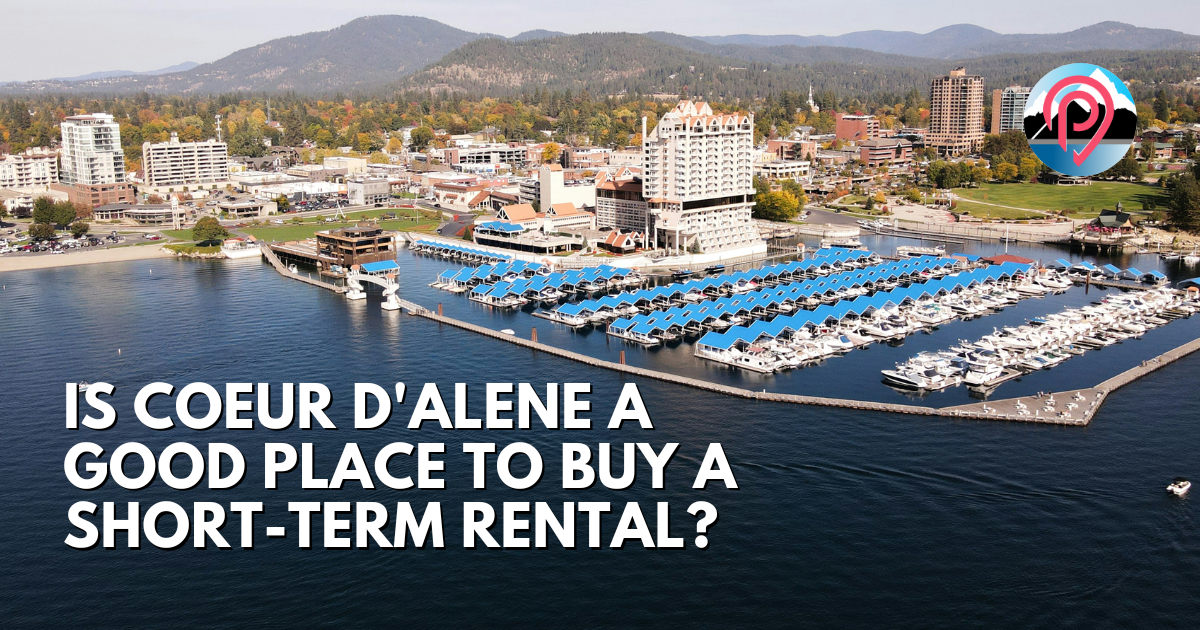
Is Coeur d'Alene a Good Place to Buy a Short-Term Rental?
Short answer: yes — but with conditions that will make or break your investment depending on where you buy, what you buy, and how you run it.
Coeur d'Alene has one of the strongest short-term rental markets in the Pacific Northwest. The demand is real, the regulatory environment is more investor-friendly than most cities its size, and the market draws exactly the kind of high-spending guests that justify premium nightly rates. But like any STR market, North Idaho rewards buyers who understand it and punishes buyers who assume every cabin near a lake prints money automatically.
This guide covers what you actually need to know before you buy — the market numbers, the regulations, the neighborhoods, the seasonality, and the questions to ask before you make an offer.
Why Investors Are Looking at Coeur d'Alene
Coeur d'Alene isn't new to the short-term rental conversation. It's been on investor radar for years, and for good reason.
 The demand drivers are consistent and diverse. Unlike single-season markets that live and die by one event, CDA draws visitors year-round across multiple reasons to travel: boating and lake recreation in summer, skiing at Schweitzer Mountain and Silver Mountain in winter, fall foliage, motorcycle rallies, weddings, hunting season, and a growing remote work relocation crowd that extends shoulder season occupancy. That diversification matters for underwriting — it means you're not entirely dependent on six weeks in July to make the numbers work.
The location is genuinely desirable. Coeur d'Alene Lake is one of the most beautiful lakes in the country, and that's not marketing copy — it's why people keep coming. Guests who stay once tend to come back, which means well-reviewed properties build repeat bookings over time.
Idaho's regulatory environment protects STR operators. Idaho Code §67-6539 limits cities and counties from effectively banning short-term rentals. In May 2025, the Idaho Supreme Court reinforced this protection by striking down a local ordinance that functioned as a de facto ban — making clear that municipalities can regulate safety and operations, but cannot create rules that amount to prohibition. As of early 2026, there is even pending legislation (SB 1162) that would further limit how aggressively cities can regulate STRs, capping permit fees at $50 and eliminating neighbor notification requirements. The regulatory trajectory in Idaho is more investor-friendly than most states, not less.
Property values have appreciated significantly. The median sale price in Coeur d'Alene is around $799,500 as of recent data. That creates a high entry point — but it also means you're buying into an asset that has demonstrated sustained appreciation, not just a yield play on a flat market.
The Market Numbers: What STRs in CDA Actually Earn
Here's what the data shows across major STR analytics platforms for the Coeur d'Alene market:
A few important notes on these numbers:
First, averages obscure the wide performance gap between the top quartile and the bottom quartile. A well-positioned lakefront property with professional photos, dynamic pricing, and strong management can earn significantly more than these averages suggest. An inland property that's poorly photographed and statically priced can earn less.
Second, seasonality is real and significant. Peak July rates run two to three times what March rates will bring in. Your underwriting needs to model the full 12-month calendar, not just peak season revenue multiplied out. Well-run properties in CDA can achieve solid annual occupancy through thoughtful off-season pricing and positioning toward remote workers, extended-stay guests, and shoulder-season travelers.
Third, lakefront properties and those with mountain views, hot tubs, or private dock access compress yields but command a substantial premium in gross revenue. If your goal is maximum yield (cap rate), you may find better numbers slightly inland at a lower purchase price. If your goal is appreciation and high gross revenue, waterfront wins.
Coeur d'Alene STR Regulations: What You Need to Know Before You Buy

Before you make an offer on any property, understand exactly how the permit system works. This is one of the most misunderstood parts of buying an existing STR.
Inside City of Coeur d'Alene Limits
- Annual permit required. Any property rented for 30 consecutive days or less must have an STR permit issued by the City of Coeur d'Alene. Permits are tied to the property owner — not the property — which means they must be renewed annually by March 1 each year.
- Permits do not transfer upon sale. This is critical. When you buy an existing STR inside city limits, you are buying a property that can be permitted — not one that comes with an active permit. You'll need to apply for your own permit after closing. Factor in the processing timeline (which can take days to several weeks) when planning your launch date.
- One unit per parcel. You can only operate one STR per parcel inside the city. This affects ADU strategies — if you want to rent both a main house and a detached cottage, you need to confirm whether both units qualify under current ordinance (which requires owner occupancy in one unit for ADU configurations).
- Safety and compliance requirements. Your property will need to meet fire safety standards including smoke and CO detectors, fire extinguishers, posted egress plans, and occupancy limits based on square footage and bedroom count.
- Neighbor notice at application. The city's STR ordinance requires neighboring property owners to be notified when a permit application is filed. This is procedural — it doesn't give neighbors veto power — but it's part of the process.
Outside City Limits: Kootenai County
Properties in unincorporated Kootenai County operate under different — generally less restrictive — rules than properties inside the city. The county has been actively discussing STR regulations, so verify the current requirements directly with the county planning department before closing.
If you're looking at a property that's technically in Post Falls, Hayden, or another neighboring city, those jurisdictions each have their own STR ordinance. Don't assume what applies in CDA applies in adjacent cities.
The Bottom Line on Regulations
Idaho's STR-friendly state law and the May 2025 Supreme Court decision make it very unlikely that Coeur d'Alene will enact a dramatic crackdown on short-term rentals. You're buying into a market where the legal framework protects your right to operate. That said, regulations can and do evolve — so build your underwriting on what's currently permitted, and stay informed on any council discussions about updates to the ordinance.
Best Property Types for Short-Term Rentals in North Idaho
Not every property type performs equally in this market. Here's what tends to work — and why.
Lakefront and Lake-View Properties
 Best for: Maximum gross revenue, strong appreciation, desirable guest experience
Lakefront properties on Coeur d'Alene, Hayden, Twin, or Fernan Lakes command the highest ADRs in the market — top-performing lakefront STRs can earn well above market averages in peak season. Buyers pay a steep premium for these properties, which compresses cap rates, but the appreciation history and guest demand are strongest here.
What to look for: Private dock or dock access, water frontage, unobstructed views, outdoor living space. These features are the ones guests specifically search for and pay premium rates to access.
What to watch: HOA rules. Lakefront communities sometimes have HOAs with restrictions on short-term rentals. Read the CC&Rs carefully before making an offer on any lakefront property.
Cabins and Mountain Properties
Best for: Year-round demand, skiing and outdoor recreation guests, lower entry price than lakefront
A well-positioned cabin near Schweitzer Mountain or Silver Mountain captures both winter ski guests and summer outdoor recreation visitors. These properties often offer better yield (cap rate) than lakefront because the purchase price is lower relative to rental income potential.
What to look for: Hot tub (significant revenue impact — STR data shows hot tub properties earn substantially more annually in mountain markets), easy snow access/plowing, proximity to trailheads and ski areas, cozy aesthetic that photographs well.
In-Town Properties Near Downtown CDA
 Best for: Year-round moderate occupancy, event-driven demand, couples and small groups
Walkable properties near downtown Coeur d'Alene, the resort, and the lakefront boardwalk capture wedding guests, event attendees, Ironman participants, and people who want the lake town experience without driving to a cabin. These properties tend to have more consistent year-round occupancy, even if peak nightly rates don't match lakefront.
What to look for: Walkability, parking (the city's STR ordinance requires compliant off-street parking), proximity to the resort area and restaurants.
What to Avoid
Inland properties with no standout feature. A 3-bedroom ranch house 20 minutes from the lake with no mountain view, no hot tub, and no distinguishing characteristic will struggle to compete against the hundreds of more compelling options in this market. If you can't articulate in one sentence why a guest would specifically choose your property over others, reconsider.
Properties in HOAs that restrict or prohibit STRs. Always request the complete HOA governing documents and ask directly about any STR restrictions. A property that can't be legally operated as a short-term rental under its HOA is worth zero as an STR investment regardless of what it could earn.
Seasonality: Modeling the Full Year

This is where many first-time STR buyers get caught off guard. Here's a realistic picture of the seasonal demand cycle in North Idaho:
Peak Season (June – August): This is where you make the bulk of your annual income. July 4th weekend, Ironman Coeur d'Alene, summer lake season — occupancy and ADRs are at their highest. Demand significantly outstrips supply in this window. Expect 80–90%+ occupancy for well-positioned properties. Price aggressively and set minimum stay requirements (3–5 nights) to reduce turnover costs.
Shoulder Season (September – October): Fall foliage drives leaf-peeper traffic from September into early October. The motorcycle crowd rolls through in September. Wedding season extends into October. Strong occupancy is achievable at slightly reduced rates. This is often when the most loyal, repeat guests visit — they want the area without the peak-season crowds.
Winter (November – March): This is where less-prepared investors panic and over-discount. Ski season at Schweitzer and Silver Mountain is a real demand driver, but it doesn't replace summer volume. Strategic operators target ski groups with multi-night minimums, remote workers with monthly stays, and holiday travelers in December. Properties positioned as "cozy winter cabin" with a hot tub and fireplace maintain much better occupancy than those that feel like a lake house waiting for summer.
Spring (April – May): The quietest period. Shoulder rates, slower bookings, good time for maintenance, repairs, and refresh. Build this period into your underwriting as a lower-revenue window — don't model peak rates across 12 months.
The takeaway for underwriting: Model revenue conservatively for November through May, realistically for September–October, and at full capacity for June–August. A 12-month model built this way will give you a much more accurate picture of what to expect than a back-of-napkin calculation based on July rates.
How to Evaluate a Specific Property
When you find a property you like, here's how to assess it as an STR investment specifically:
 1. Get the real income documentation. If the property is currently operating as an STR, request 2–3 years of income statements, occupancy data, and ADR history from the current owner. Ask for the Airbnb Proof of Earnings PDF directly. Don't accept verbal claims about what it "could" earn.
2. Calculate NOI and cap rate. Run the actual numbers: gross income minus all operating expenses (cleaning, platform fees, property management if applicable, supplies, utilities, insurance, property taxes, any HOA dues) equals NOI. Divide NOI by purchase price to get cap rate. In North Idaho, current cap rates for STRs typically range from 4–7% on well-performing properties, with lakefront sometimes compressing below 4% due to premium purchase prices. Know what you're buying before you commit.
3. Verify the permit status and transferability. Ask whether the property has a current active STR permit. Ask the city directly how long a new permit application takes to process. Know that you'll need to apply in your name after closing and plan your launch timeline accordingly.
4. Check the HOA. If there's an HOA, get the full CC&Rs and ask directly: are short-term rentals allowed? Have any restrictions on STRs been discussed or proposed recently? Are there any active violations or complaints against the property?
5. Run the Airbnb comparables yourself. Search Airbnb for similar properties in the same area, same bedroom count, with comparable features. Look at their pricing, reviews, and calendar availability. This gives you a much more grounded sense of what the market will actually bear than any data report.
6. Evaluate the property as a guest. Book a night at a comparable listing (or simply read through the reviews of the most-reviewed properties nearby). What do guests love? What do they complain about? Your job as a new operator is to build a product that earns consistent 5-star reviews — and that starts with understanding what guests in this specific market care about.
7. Think about management. Will you self-manage or hire a property management company? Self-management from out of state is operationally demanding but keeps more margin. Local management companies typically charge 20–30% of gross revenue but handle everything. Factor your management approach into your NOI calculation before you underwrite.
The Tax Picture for Buyers

A few tax items to keep in mind from day one:
Idaho state sales tax and travel & convention tax. STR operators in Idaho are responsible for collecting and remitting a 6% state sales tax plus a 2% Travel and Convention Tax on short-term rentals. Airbnb and VRBO collect and remit these taxes on your behalf in Idaho, but confirm your registration status with the Idaho State Tax Commission.
Depreciation is your friend. As a rental property, you can depreciate the structure (not the land) over 27.5 years under federal tax rules. This creates a paper loss that offsets rental income, reducing your tax liability. Talk to a CPA who works with rental property owners before your first tax filing.
Mortgage interest deduction rules. If you also use the property personally, the IRS has specific rules about how to allocate expenses between personal and rental use (the "14-day rule"). Keep clean records from day one.
1031 Exchange for future flexibility. If you eventually sell this property, a 1031 Exchange lets you defer capital gains by rolling proceeds into a like-kind investment property. Understanding this now — before you buy — helps you think about your long-term hold and exit strategy.
This isn't tax advice. Work with a CPA experienced in short-term rental and real estate investment before you buy and before you file. The rules are specific enough that general tax advice will cost you money.
Frequently Asked Questions
Do I need a permit to operate an STR in Coeur d'Alene? Yes. Any property rented for 30 consecutive days or less inside city limits requires an annual STR permit from the City of Coeur d'Alene. Permits are non-transferable — even if you're buying an existing STR, you'll need to apply for your own permit after closing. Properties outside city limits fall under Kootenai County jurisdiction, which has different (generally less restrictive) requirements.
Can I buy an existing Airbnb and take over the listing? No. Airbnb accounts and listings are tied to individual hosts, not properties, and cannot be transferred per Airbnb's Terms of Service. The seller's reviews, Superhost status, and listing cannot carry over to you. You'll start fresh with a new account and listing. You can ask the seller to share their listing photos, description text, and pricing history so you can launch your own listing more efficiently.
Is Coeur d'Alene going to ban short-term rentals? Extremely unlikely. Idaho state law (§67-6539) explicitly limits cities and counties from effectively banning STRs. The Idaho Supreme Court reinforced this in May 2025. As of early 2026, pending legislation would go even further in protecting STR operators from restrictive local ordinances. Idaho is moving in the investor-friendly direction, not away from it.
What's the best type of property for STR in North Idaho? Lakefront and lake-view properties command the highest gross revenue. Cabin-style properties near ski areas often offer better cap rates due to lower entry prices. In-town properties near downtown CDA provide consistent year-round occupancy. A hot tub materially increases revenue in nearly every category.
How much does it cost to operate an STR in CDA? Operating costs vary significantly based on your management approach. Budget for platform fees (3% for Airbnb hosts, higher for VRBO), cleaning costs, supplies, regular maintenance, STR insurance (specialized STR insurance differs from standard homeowner's insurance — your current policy likely doesn't cover commercial short-term rental use), property taxes, and any HOA or permit fees. A property management company will add 20–30% of gross revenue but eliminates most day-to-day operational demands.
Should I use a local agent or an online buyer's agent to find an STR? Use a local agent who has specific experience with STR and investment property transactions in North Idaho. The nuances — permit status, which HOAs are STR-friendly, which neighborhoods produce the strongest STR demand, how to evaluate income documentation in an offer — require local knowledge that a generalist agent in another market won't have.
Ready to Buy a Short-Term Rental in North Idaho?
The Persinger Group specializes in investment and short-term rental property transactions throughout Kootenai County. We know which neighborhoods produce the strongest returns, how to evaluate income documentation in an offer, and how to navigate the permitting process so you can start earning income as quickly as possible after closing.
If you're already on the other side of an STR investment and considering selling, read our complete guide: How to Sell a Short-Term Rental in North Idaho.
Contact the Persinger Group to talk through your specific investment goals and what's currently available in the North Idaho STR market.
And when you’re ready here are 4 ways we can help you right now…
1. Read this article - Put The Hammer Down: Instead of Expensive Remodeling Do These 5 Low-Cost Changes That Add the Most Value to Your Home
2. If you’re a first-time homebuyer - get your free guide, 7 Costly Mistakes Home Buyers Make, visit http://costlymistakeshomebuyersmake.com
3. If you’re SELLING your home - get access to our Get Sell Ready guide and checklist. It will show you how to get your home ready for sale without spending a fortune or wasting your nights and weekends updating and remodeling your home. http://getsellready.com
4. Start a Smart Moves Conversation with us… get clarity about what to do next, get your questions answered, your concerns are taken care of, and an action plan customized to your timeline. Schedule a call at http://smartmovescall.com or start a chat at http://m.me/persingergroup

