


Updated October 12, 2026.
You do not need an Aspen address to build skiing into your life. You do need a town where the housing, mountain and everyday routine work together.
This guide focuses on 18 ski-town and city-base candidates. It compares the ownership choices they offer, the skiing nearby and the compromises that come with a smaller budget. A short section covers community hills and private clubs, followed by a handful of alternatives that belong in a different price or lifestyle category.
The goal is a useful shortlist. A place does not qualify just because it has a lift nearby, and “cheaper than Aspen” is not a sufficient definition of affordable.
Kellogg, Wallace, Anaconda and Pocatello are worth comparing for substantial western skiing. Ironwood, Berlin and Rumford offer a different working-town search. Ogden and Logan provide relative Utah value, while Brian Head requires a condo-specific comparison. Each offers a different combination rather than the same ski experience at a lower price.
Only downhill skiing and snowboarding are included. Prices keep their reporting dates and property categories. The selections are editorial candidates, not a verified ranking of the 18 cheapest housing markets in America.
The shortlist: choose the skiing and town setting first
| Candidate | Downhill connection | Why it makes the shortlist | Main compromise |
|---|---|---|---|
| Kellogg, Idaho | Silver Mountain | Substantial terrain and a gondola terminal in town | Gondola-dependent access and property-specific expenses |
| Wallace, Idaho | Lookout Pass and Silver Mountain | Another Silver Valley home base | Drive to the mountain rather than a lift in town |
| Anaconda, Montana | Discovery | A smaller town near a mountain with advanced terrain | Town homes and lake properties are different markets |
| Butte, Montana | Discovery | A working-city alternative in the same region | A longer skiing journey |
| Pocatello, Idaho | Pebble Creek | City life with meaningful western vertical | Limited resort-village atmosphere |
| Chewelah, Washington | 49 Degrees North | A small town with a substantial regional mountain | Small-town services and a mountain drive |
| Ogden, Utah | Snowbasin, Powder Mountain, Nordic Valley | Several mountain choices from a city base | Relative value; skiing access is not automatically cheap |
| Logan, Utah | Beaver Mountain | A university city with a substantial local mountain | Logan Canyon travel |
| Brian Head/Cedar City, Utah | Brian Head | A resort-condo search or a separate city-base option | Fees, unit size and the difference between the two locations |
| Casper, Wyoming | Hogadon Basin | Local downhill skiing alongside ordinary city life | Compact terrain compared with Jackson Hole |
| Laramie/Centennial, Wyoming | Snowy Range | Family-mountain skiing from two different home bases | Modest mountain scale and winter travel |
| Ironwood, Michigan | Western Upper Peninsula mountains | Working-town housing and several regional ski choices | Shorter vertical, remoteness and older-home upkeep |
| Cadillac, Michigan | Caberfae Peaks | Practical Lower Peninsula family skiing | Regional terrain and snowmaking-supported conditions |
| Wausau, Wisconsin | Granite Peak | A city base with a developed Wisconsin mountain | Shorter runs than substantial western mountains |
| Berlin, New Hampshire | Wildcat | Working-town housing within a lower-priced northern county | Drive to skiing and older buildings |
| Rutland City, Vermont | Pico and Killington | A city-based alternative to resort-area ownership | Travel to the mountain and neighborhood selection |
| Rumford, Maine | Black Mountain of Maine | A working-town base and nonprofit mountain | Smaller terrain than Maine's largest resorts |
| Davis, West Virginia | Timberline and Canaan Valley | Two downhill choices in an Appalachian setting | Variable weather and different town/resort property costs |
The strongest financial comparison is always between actual suitable properties. Where this guide uses county or association-area data, it identifies that geography rather than calling it a town median. Where a comparable price series has not been established, the town remains a buying candidate rather than a proven cheapest-market winner.

Mission Ridge near Wenatchee, Washington, photographed February 6, 2025. This image illustrates western mountain terrain; it does not establish conditions for a future visit. Photo: Buidhe. CC BY-SA 4.0. Original image. Resized and converted to WebP; original license retained.
In this guide
- Famous ski resorts: home prices and peak-season stay costs
- What makes a ski town affordable?
- Compare a buying budget, not a town-wide estimate
- Affordable western ski-town candidates
- Midwest ski-town candidates: Michigan and Wisconsin
- Eastern and Appalachian ski-town candidates
- Community ski hills: cheaper skiing, with a separate housing question
- Private skiing: a separate budget category
- Other places worth considering, with a clear reason for the extra cost
- Is Wisconsin or Michigan skiing as good as Kellogg or the East Coast?
- What does it really cost to own a ski home?
- A practical buying process
- Frequently asked questions about affordable ski towns
- Sources, dates and how to read the comparisons
Famous ski resorts: home prices and peak-season stay costs
The familiar resort names establish the expensive end of the search, but a useful price anchor has to say what was sold, where and when. A detached-home average, a condo median and a county-wide figure answer different questions. The examples below therefore retain their property category and reporting period rather than being presented as a uniform ranking.
| Resort market | Reported purchase-price anchor | Property category and period | How to read it |
|---|---|---|---|
| Aspen, Colorado | About $16.85 million | Average single-family sale price, Jan.–June 2026 | A luxury-market average, heavily influenced by expensive sales; not the price of every Aspen home |
| Aspen, Colorado | About $5.85 million | Average condo sale price, Jan.–June 2026 | Separates the attached-home market from detached homes |
| Park City, Utah | $2.3 million | Median condo sale price within Park City limits, rolling year ending June 30, 2026 | A city-limits condo figure, not the entire surrounding MLS region |
| Jackson Hole, Wyoming | $2.995 million | Overall median sale price in the report's market, first half of 2026 | A mixed-market figure, not a detached-home-only or town-of-Jackson median |
| Vail/Beaver Creek, Colorado | See the dated holiday-stay examples below | Individual two-bedroom accommodation advertisements | A vacation-cost anchor; not a housing-market statistic |
The Aspen figures come from a local brokerage's published midyear transaction report. Park City's condo figure comes directly from its local REALTOR association. Jackson Hole's figure comes from a local market-report publisher. Source details are collected at the end of this guide so the comparisons remain easy to read.
Those numbers establish why buyers look beyond the famous addresses. They do not mean every listing costs millions or that every smaller town is a bargain. The next step is comparing the same kind of property: an ordinary detached house with another detached house, or a condo with another condo after adding its fees.
What does it cost just to stay during peak season?
Buying is one comparison. Booking a family ski week is another. Peak dates can make even a short introduction to a famous resort expensive before anyone buys a lift ticket.
For a concrete example, the following owner-advertised timeshare rentals were displayed for Presidents' Day week in February 2027. These are individual asking prices collected from RedWeek, not completed bookings, hotel averages or a promise of availability. All examples below have two bedrooms, but locations, occupancy limits and amenities differ. Confirm taxes, platform charges, cancellation terms and the final checkout total separately.
| Advertised stay | Dates | Seven-night asking price | Approximate nightly equivalent |
|---|---|---|---|
| Marriott's StreamSide, Vail | Feb. 13–20, 2027 | $4,412 | $630 |
| Westin Riverfront Mountain Villas, Avon/Beaver Creek area | Feb. 13–20, 2027 | $6,009 | $858 |
| Valdoro Mountain Lodge, Breckenridge | Feb. 13–20, 2027 | $4,166 | $595 |
| Grand Lodge on Peak 7, Breckenridge | Feb. 14–21, 2027 | $6,510 | $930 |
Sources: Vail/Beaver Creek holiday listings and Breckenridge holiday listings.
There were also less expensive studios and one-bedroom advertisements. Larger accommodations can cost more. This is why a claim such as “Vail costs $900 a night” is too blunt: some stays do, some do not, and the room configuration matters.
The useful anchor is that a family-sized holiday accommodation can consume roughly $4,000–$6,500 for the week in these observed examples. Ski access, meals, transportation, equipment and lessons are additional. Those costs explain why a cheaper home base can matter even to someone who has no intention of buying property.
A fair comparison uses the same dates, bedroom count, party size and cancellation flexibility. A roadside motel in January cannot establish the savings against a slopeside two-bedroom condominium over Presidents' Day. Conversely, a traveler who is happy with that motel should not be told they need to pay for a luxury condominium to have a ski vacation.
A transparent trip-budget illustration
Here is a planning exercise, not a set of live lodging quotes. Assume four people, five nights, three ski days each and a lodging unit suitable for the group. The ticket figure is an assumed average across the party; children's pricing, passes and promotions may change it substantially.
| Assumption | Expensive destination scenario | Less expensive home-base scenario | Community-hill scenario |
|---|---|---|---|
| Lodging, five nights | $700/night = $3,500 | $200/night = $1,000 | $150/night = $750 |
| Ski access, 12 person-days | $200/person-day = $2,400 | $80/person-day = $960 | $30/person-day = $360 |
| Lodging plus ski access | $5,900 | $1,960 | $1,110 |
The assumptions show how the arithmetic works; they do not establish that a particular town offers those rates on your dates. Flights, driving, food, rentals, lessons, taxes and fees are excluded. The point is that a cheaper lodging market and cheaper skiing can work together. A distant bargain can also lose its advantage if travel is expensive or the skiing is unsuitable for the group.
What makes a ski town affordable?
Three different purchases get confused in ski-town lists: a town house, a resort condo and a vacation. They need different budgets.
For a primary home, affordability includes local income or a dependable remote income, ordinary services and annual ownership costs. For a second home, travel and actual use matter. For a vacation, lodging and skiing costs on your dates may matter more than the town's home prices.
A low-priced condo with large dues is not necessarily cheaper to own than a modest detached home. A town with an inexpensive family hill may have expensive lakefront housing. A working city can offer useful ownership options while still requiring a substantial drive to skiing.
Use these filters before selecting a town:
- A property type and annual ownership budget that fit the household.
- Downhill terrain you will enjoy repeatedly, not simply a large snowfall headline.
- A winter journey that works on ordinary days.
- A town you can enjoy and use outside ski season.
The core profiles focus on ordinary-town ownership, city-base alternatives and a specific resort-condo case. The smaller hills and private products appear separately because an affordable skiing product does not establish affordable nearby housing.
Compare a buying budget, not a town-wide estimate
A useful ski-home search begins with what the budget can buy. Choose a price ceiling, then compare property type, condition, annual expenses and the winter journey to the mountain. A small condo and a three-bedroom detached house should not be called equivalent bargains simply because their asking prices match.
| Purchase-budget search | What to compare | What can change the apparent bargain |
|---|---|---|
| Under $250,000 | Available smaller homes, condos and renovation properties | Major repairs, very small units, land-only listings, leased land and association costs |
| $250,000–$400,000 | Detached homes versus condos in the same town and actual ski-access area | Renovation standard, winter access, taxes, dues and the availability of suitable listings |
| $400,000–$600,000 | Space, condition and convenience across several regional home bases | A pricier town may offer less house; a farther location may add a difficult drive |
| Above $600,000 | Whether extra spending buys better skiing access or mostly a more desirable address | Resort premiums, lakefront or acreage premiums, and the cost of amenities you may rarely use |
These are search brackets, not claims that every town has suitable homes in each bracket. They help compare real choices without assigning a single price to every home in a community.
A local MLS example: the Silver Valley versus the Schweitzer region
The Coeur d'Alene Regional REALTORS' September 2026 snapshots report a $313,000 year-to-date median sale price in Shoshone County, which includes Kellogg and Wallace, and $543,000 in Bonner County, which includes Sandpoint. Both snapshots cover site-built single-family homes on less than two acres, with data reported as of October 5, 2026.
The difference is $230,000, with the Shoshone County median about 42% below Bonner County's. This is a reasonably consistent regional comparison because the source, period and property category match. It is still a county-to-county comparison. It does not establish a Kellogg city median, a Sandpoint city median or the price of a condo at Schweitzer.
For a buyer, the implication is worth investigating: the Silver Valley may provide a less expensive ownership route to substantial downhill skiing. The deciding comparison remains actual homes near Silver Mountain or Lookout Pass versus actual homes serving the Sandpoint/Schweitzer lifestyle.
Read location labels carefully. Rutland City differs from Rutland Town. Ogden city differs from Eden and Huntsville in Ogden Valley. A Davis mailing address may cover a town home or a resort-area property. The right comparison follows the actual home and ski route.
Additional published housing context
These observations help put several candidates in context. They are not interchangeable town medians and should not be sorted into a national ranking.
| Search area | Published sale-price observation | Geography, category and period |
|---|---|---|
| Berlin and northern New Hampshire | $251,000 | Coos County single-family median, Jan.–Aug. 2026; New Hampshire REALTORS/PrimeMLS |
| Ogden area | $483,785 | Weber County single-family median over the year ending Sept. 30, 2026; brokerage report using WFRMLS |
| Logan area | $499,990 | Cache County single-family median over the year ending Sept. 30, 2026; brokerage report using WFRMLS |
| Pocatello association market | $340,000 | Association-area combined single-family/townhome/condo median, March 2026 snapshot published by Pioneer Title |
| Rumford's county | $369,950 | Oxford County existing single-family median, March–May 2026; Maine Listings report |
Coos County's year-to-date median provides a useful northern New Hampshire anchor. It does not establish the price of a renovated Berlin house. The Utah county numbers explain why Ogden and Logan belong in a relative-value category rather than a cheapest-housing category. The Pocatello snapshot combines property types and is older; it cannot be compared as if it were a current detached-home-only town median.
Oxford County includes different communities and recreation markets. Its figure supports regional context for Rumford rather than a claim that a Rumford home costs the county median. The same care applies to the Silver Valley county comparison above.
Affordable western ski-town candidates
1. Kellogg, Idaho: Silver Mountain and a town-based gondola connection
Kellogg's appeal starts with an unusual combination: comparatively accessible housing and a substantial ski mountain reached by a gondola from town.
Silver Mountain also offers lodging, an indoor waterpark and golf. Its history describes a mountain-bike program that expanded after its 2013 relaunch. Those activities matter because a home here can serve more than one season of recreation.
The strongest reason to consider Kellogg is not that it might someday become famous. It is that the skiing connection already exists. You can evaluate that benefit today.
The housing picture: The local association reports a $313,000 year-to-date median for qualifying Shoshone County single-family sales through September 2026. That is regional context, not a Kellogg-only figure. Compare ordinary town homes with resort condominiums separately, including fees, condition and access to the gondola.
The compromise: Kellogg is still a working Silver Valley community. Buyers expecting an extensive resort village should spend time in town before deciding. The gondola also matters operationally: access from town depends on that lift's schedule and availability.
The Bunker Hill environmental cleanup area is another property-specific consideration. Review cleanup records, disclosures and applicable requirements for the actual parcel. A broad label cannot tell you a particular home's condition.
Best fit: Buyers who want western skiing close to home and value convenience more than a prestigious resort address.
Silver Mountain's official statistics list more than 1,600 acres, 2,200 vertical feet and 340 inches of average annual snowfall. This is substantial western terrain, including groomed runs and off-piste skiing. Natural coverage, temperature and gondola operations affect the actual day, so the snowfall average is not a holiday-week guarantee.
The nearby price anchor is Sandpoint and Schweitzer. The matching local association snapshots show a $313,000 Shoshone County median versus $543,000 in Bonner County for the reported single-family category. That regional gap supports a serious comparison, while the specific home and ski experience determine the purchase. Schweitzer condos require their own comparison.
Why it stays on the shortlist: The mountain is substantial, the gondola relationship exists now and matching regional sales data provide a useful affordability comparison. A future development boom is not needed to make the case.
2. Wallace, Idaho: A different way to buy into the Silver Valley
Wallace belongs in the same regional search as Kellogg, but the two towns should not be treated as identical.
Wallace gives buyers another Silver Valley housing market while retaining road access to the region's ski areas. Lookout Pass is associated with the Idaho-Montana border near Mullan; Silver Mountain is based in Kellogg. Neither provides lift access from downtown Wallace.
The housing picture: Wallace shares Shoshone County with Kellogg, but the $313,000 regional median does not establish which town offers the better individual purchase. Compare home condition, layout and the journey to the mountain you expect to use most.
The compromise: You trade Kellogg's direct gondola connection for a different home base and driving routine. In a small market, finding the right layout, garage, driveway and condition may matter more than the difference between town averages.
Buyers should also review Silver Valley environmental information for the specific property. Older homes deserve close attention to foundations, drainage, wiring and previous renovations.
Best fit: Buyers who want to compare several Silver Valley towns before choosing a home and do not require a lift connection from town.
Lookout Pass currently advertises 1,023 acres, 1,650 vertical feet and more than 450 inches of annual snowfall. The operator's snowfall claim should be treated as a reported average, not a uniform measurement against every other mountain. The terrain expansion makes older descriptions of Lookout as a much smaller hill obsolete.
Wallace offers a different starting point from the gondola-in-town relationship at Kellogg. For strong skiers, Lookout and Silver can complement each other; for a property purchase, decide which mountain determines most winter journeys. Use the county comparison with the Sandpoint region as context, then compare like-for-like properties.
Why it stays on the shortlist: It provides another way to own in the Silver Valley while choosing between two real mountains. The decision is about the town and the route, not a claim that every Wallace home beats every Kellogg home.
3. Anaconda, Montana: Mountain living near Discovery
Anaconda is worth examining if the goal is a Montana community near skiing without making a luxury resort village the center of the purchase.
Discovery Ski Area's lodging guide identifies Anaconda as a base for visiting the mountain. Its general town description gives a 25-minute trip, while individual Anaconda lodging entries show roughly 32 to 40 minutes. That variation is a useful reminder: the actual address and route matter more than a single advertised drive time.
The housing picture: Compare Anaconda town homes separately from Georgetown Lake properties, rural acreage and recreation cabins. A lower asking price can reflect a different location or substantial repairs rather than a better-value version of the same home.
The compromise: You will drive to skiing. If frequent short sessions are the goal, test whether the round trip feels practical. If full ski days are the goal, the same distance may be easier to accept.
Anaconda also has an industrial cleanup history. The EPA's Anaconda Smelter information describes residential remediation and continuing cleanup work. Buyers should establish the status of the actual parcel and any applicable management requirements.
Best fit: Buyers seeking a smaller Montana community and a nearby mountain rather than resort-village living.
Discovery's mountain statistics list 2,200 acres of total patrolled area, 2,388 vertical feet and 215 inches of annual snowfall, with snowmaking on four runs. Its terrain includes easy skiing and demanding advanced sectors. A family should inspect the front-side learning options as carefully as an expert inspects the steeper terrain.
The relevant Montana anchors are the better-known Bozeman and Big Sky recreation markets. Anaconda offers a different town, budget and mountain relationship rather than the same resort experience at a discount. Discovery's limited listed snowmaking coverage also means natural snow conditions matter when judging terrain availability.
Why it stays on the shortlist: Discovery offers terrain that can keep experienced skiers interested. An ordinary town-home search is distinct from buying into a famous resort market or paying for lakefront recreation property.
4. Butte, Montana: A working-city alternative near Discovery
Butte complements Anaconda rather than replacing it. Both can enter the search around Discovery, but their mountain journeys and everyday environments differ.
Butte and Anaconda provide different housing searches around the same mountain. Compare similar homes and their actual ski journeys. Discovery advertises 2,200 acres of total patrolled terrain, 2,388 vertical feet and 215 inches of annual snowfall. Its easy and demanding terrain means this comparison need not involve settling for a practice hill.
The regional price anchor is the better-known southwest Montana resort and recreation markets around Bozeman and Big Sky. Butte trades their resort reputation for a working-city setting. It also trades convenience to particular mountains: low housing prices cannot make Discovery's drive disappear.
Older buildings, winter heating and the area's industrial history deserve property-specific attention. A renovated house and a low-priced project home may have very different annual budgets.
Best fit: A buyer who wants city services in this part of Montana and is willing to make a deliberate ski trip. If skiing several short sessions every week is essential, Anaconda or another closer location may justify a higher purchase price.
Why it stays on the shortlist: It broadens the same skiing search for buyers who need more of a working-city environment. Its financial case must be weighed against additional travel rather than assuming proximity alone makes it a bargain.
5. Pocatello, Idaho: Skiing alongside everyday city life
Pocatello is a practical option for someone who wants skiing to fit around daily life rather than dictate the entire choice of town.
Pebble Creek is near Inkom, a short drive from Pocatello. The operator lists 1,100 acres and 2,200 feet of vertical drop. That makes it worth evaluating on its actual terrain rather than dismissing it because Pocatello is not a famous ski-town name.
The housing picture: Compare Pocatello neighborhoods for both everyday routines and the route to Pebble Creek. A house that saves ten minutes on ski mornings may add time to every workday. Evaluate detached-home sales and available listings rather than combining them with condos or vacant land.
The compromise: This is a city-based skiing choice. You are buying a place to live and using the nearby mountain, not buying into a slopeside village. That can be a benefit for buyers who prefer a broader town setting.
Pebble Creek's official terrain breakdown includes substantial advanced terrain as well as beginner and intermediate runs. If the household includes new skiers, assess the lesson program and terrain they will actually use rather than buying solely for the strongest skier.
Best fit: Full-time residents who want regular skiing while maintaining an ordinary city routine.
Pebble Creek reports 225 inches of average annual snowfall and a typical season from mid-December through late March. Its terrain breakdown is weighted toward advanced and expert skiing, with a meaningful beginner and intermediate component. The large vertical makes it a credible alternative for experienced skiers, while its learning setup deserves an in-person family test.
The regional anchor is the Sun Valley-area dream rather than an equivalent resort-village purchase. Pocatello trades a famous destination setting for an ordinary city and its local mountain. That can be a favorable trade for full-time life, especially when the home supports work and services during the rest of the year.
Why it stays on the shortlist: Pebble Creek offers substantial vertical, while the city supports a full-time home-base decision. The March 2026 association snapshot reported a $340,000 combined residential median; that is dated association-market context, not a current Pocatello detached-home quote.
6. Chewelah, Washington: Small-town living with 49 Degrees North
Chewelah is one of Washington's clearest answers to the question of where smaller-town housing and substantial downhill skiing overlap. 49 Degrees North provides a broad network of groomers, trees and multiple mountain areas. It belongs in the substantial regional-mountain category rather than the community-hill category.
Sandpoint and Schweitzer provide a relevant regional anchor for Chewelah. Compare ordinary homes serving 49 Degrees North with ordinary homes serving Schweitzer, then add skiing costs and travel. A Schweitzer resort condo is a different product from a Chewelah detached home.
Interior Northwest skiing can deliver excellent natural snow, but warm storms and coverage fluctuations remain possible. Consult the mountain's own recent reports rather than selecting a trip from a single historical snowfall number. The area's tree skiing and terrain variety matter to stronger skiers; families should also study the learning facilities and lift arrangement.
The compromise: This is a small community with a drive to the mountain. Buyers who need a large employment market or frequent air travel may prefer Spokane even if the home and ski routine look different. The choice is between ways of living, not simply between price tags.
Best fit: Someone who wants a small Washington town and a mountain with enough variety for repeated full days.
Why it stays on the shortlist: It is a clear small-town relationship to substantial downhill terrain. Compare actual suitable homes with the Sandpoint/Schweitzer lifestyle rather than paying for a famous destination name by default.
7. Ogden, Utah: A broader community with multiple ski choices
Ogden deserves consideration when one nearby ski area is not enough or when the buyer wants the everyday setting of a larger community.
Visit Ogden identifies Snowbasin, Powder Mountain and Nordic Valley as the region's main downhill options. Their locations, terrain and pricing are different, so access to all three should not be translated into one assumed ski budget.
The housing picture: Ogden city, Eden and Huntsville require separate searches. Compare an ordinary city home with a similar property, then decide whether paying more to be closer to the mountains improves the whole household routine.
The compromise: You still have to reach the slopes. The Utah Department of Transportation's Ogden Valley resource provides winter road information, underscoring why the mountain trip deserves attention.
Do not compare an Ogden city housing figure with a house in Eden or Huntsville and assume the same pricing applies. Being closer to a resort can change the purchase substantially.
Best fit: Buyers who want several ski options and prefer a city setting to a small resort community.
Park City provides the northern Utah price anchor: its local association reports a $2.3 million median for condos within city limits over the rolling year ending June 30, 2026. That identifies a costly resort segment without assigning the same price to Ogden houses. Snowbasin and Powder Mountain provide substantial skiing; Nordic Valley provides a smaller downhill alternative. Compare each mountain's current access products.
Why it stays on the shortlist: The city gives buyers several distinct mountain choices. The published Weber County single-family median of $483,785 over the year ending September 2026 identifies relative Utah value, not bargain-basement housing.
8. Logan, Utah: Beaver Mountain and Cache Valley life
Logan offers a university-city home base rather than Park City resort ownership. Park City's reported $2.3 million city-limits condo median establishes the expensive resort segment, but it cannot establish a Logan housing discount without a matching condo comparison. Evaluate the property category you actually want.
Beaver Mountain's Ski Utah listing reports more than 828 skiable acres, 1,700 vertical feet and a marketed average of 400 inches of snowfall. The terrain distribution includes substantial beginner and intermediate skiing alongside advanced runs. This is a real alpine mountain with a local following, not an urban snowmaking mound.
The drive through Logan Canyon is central to the decision. Weather, road conditions and where you live in the valley determine the practical cost of frequent skiing. Logan offers a university-city environment, which can suit full-time households better than a purely vacation-oriented community.
The snowfall figure is a resort-reported average. It should not be treated as a guarantee of abundant snow during a particular school holiday, and it does not remove the need to check operating dates and open terrain.
Best fit: A full-time resident drawn to Cache Valley who wants substantial local skiing and can accept the canyon drive. Compare total time on ordinary mornings with Ogden's access to its own mountains before choosing on housing price alone.
Why it stays on the shortlist: Beaver Mountain has meaningful terrain and a local following. Cache County's reported $499,990 trailing-year single-family median makes the housing category clear: this is a different Utah ownership search, not one of the cheapest places in the country.
9. Brian Head and Cedar City, Utah: A lower-priced resort base with important property distinctions
Brian Head deserves a careful resort-condo search, with Park City as the expensive Utah anchor. Compare unit size, condition and total monthly expenses. A small condo can provide a lower-priced entry into resort ownership without establishing that detached Brian Head mountain homes are equally inexpensive.
Brian Head's 2025–26 resort fact sheet lists 1,232 total skiable acres, 1,320 feet of vertical and 360 inches of annual snowfall. An older general-information page still describes more than 650 acres, so the dated fact sheet is the source for the larger acreage figure here. Its high-elevation base and family-oriented terrain deserve more attention than the low housing headline alone.
Cedar City is a different proposition: a broader everyday home base with a mountain-road drive. A Brian Head resort-condo price does not establish the price of a Cedar City house, and resort convenience cannot be applied to a city property.
For condo buyers, dues, reserves, assessments, parking and unit condition are major parts of affordability. A compact unit may work beautifully for weekend use and poorly as a full-time family home. Check winter access and how the household handles altitude.
Best fit: Families and recreational skiers looking for relative resort value, or Cedar City residents comfortable with the drive. Strong skiers should study the actual terrain before assuming it replicates northern Utah's most demanding mountains.
Why it stays on the shortlist: Resort condos and ordinary city homes provide two different routes to the same mountain. Its value case is property-specific; small units and large fees must not be disguised as universally cheap resort ownership.
10. Casper, Wyoming: Hogadon Basin rather than Jackson Hole prices
Jackson Hole's reported $2.995 million overall median provides a Wyoming destination-market anchor. Casper offers a different city and a smaller local mountain. Compare specific houses rather than turning that mixed-market Jackson Hole figure into an unsupported percentage discount for Casper.
The ski relationship is Hogadon Basin, a local mountain on Casper Mountain. It is much smaller than Jackson Hole Mountain Resort. The housing discount is therefore not a way to obtain the same skiing at a different address; it is a way to build local downhill skiing into an ordinary city life.
A compact hill can still have terrain that interests experienced skiers. Study the trail map instead of assuming every small area is exclusively for beginners. At the same time, a strong skier who wants extensive terrain for every ski day may need periodic trips elsewhere.
Wind, temperature and the mountain road matter here. Choose a neighborhood with the whole week's routine in mind, then test a ski day including parking and the return trip.
Best fit: Someone who needs a Wyoming city and values a nearby local hill. The affordability case is strongest for full-time use; travelers flying from far away should compare the limited terrain with the total cost of the trip.
Why it stays on the shortlist: It pairs everyday city life with local skiing. The savings are meaningful only for someone satisfied with Hogadon's compact mountain rather than expecting Jackson Hole terrain.
11. Laramie and Centennial, Wyoming: Snowy Range's family-mountain alternative
Snowy Range advertises 30 trails and 990 vertical feet, with a displayed online weekend ticket reference of $64 at the research snapshot. Verify dates and purchase terms; that number should not be treated as every ticket price for the coming season.
Laramie provides the larger university-city base. Centennial provides the closer small-community relationship. They are different housing searches, and a property with a Centennial mailing address may still have a substantial rural access requirement.
The regional anchor is Wyoming's famous destination skiing around Jackson. Snowy Range offers a smaller, family-oriented experience that can make sense without the Jackson housing or lodging market. It does not offer Jackson Hole's vertical, terrain extent or resort infrastructure.
Weather and road conditions in southeastern Wyoming can affect the real journey. A modest mountain that you can reach regularly may be a better everyday purchase than a major resort you rarely use, but the drive still has to work in winter.
Best fit: Families, recreational skiers and residents who prefer a university community or a quieter nearby town. Experienced skiers should decide whether the local mountain is enough for most days or primarily a convenient supplement to bigger trips.
Why it stays on the shortlist: Snowy Range offers a concrete family-mountain alternative with published ticket information. Choose the university-city base or closer small-community base according to the whole household routine.
Midwest ski-town candidates: Michigan and Wisconsin
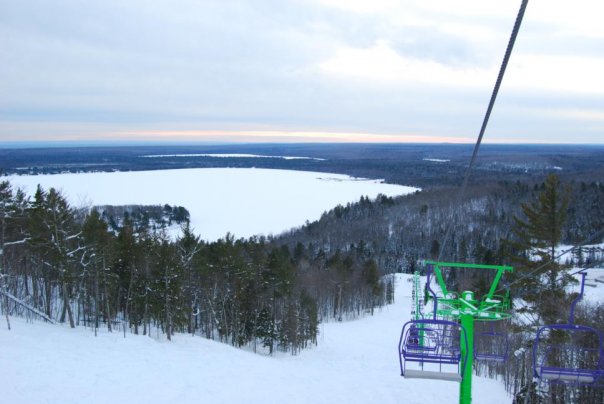
The view toward Lac La Belle from a Mount Bohemia chairlift illustrates the Upper Peninsula’s wooded ski setting and shorter descents. Photo: Archimedo. CC BY-SA 3.0. Original image. Resized and converted to WebP; original license retained.
Mount Bohemia is an expert-skiing comparison for the Midwest discussion, not a claim that it is next to every town in this section.
12. Ironwood, Michigan: A working-town search in the Upper Peninsula
Ironwood makes the case that affordable skiing does not have to mean western skiing.
The Upper Peninsula offers a different ski experience: shorter mountain runs, northern winters and a regional recreation setting. Big Powderhorn's visitor information places its village near Ironwood and Bessemer and describes other outdoor attractions in the area.
The housing picture: Investigate actual Ironwood listings and recent comparable detached-home sales. Older homes and renovation properties may create a lower-priced entry, but major repairs, heating and winter maintenance can erase an apparent bargain. Available inventory matters more than an automated town-wide number.
The compromise: This is not an inexpensive substitute for the terrain of a large western mountain. It is a different way to build skiing into your life. If you enjoy local laps, family sessions and a northern outdoor setting, the trade can make sense.
Evaluate the whole winter. A low acquisition cost can be offset by a building that needs extensive repair or is expensive to heat. For someone who travels frequently, the actual airport and driving routine also deserves a trial run.
Best fit: Buyers who prioritize lower housing costs and enjoy the Upper Peninsula's style of skiing and living.
For local variety, examine Big Powderhorn, Snowriver and other western Upper Peninsula hills rather than treating the area as one mountain. Nearby northern Wisconsin options add another search. Their shorter vertical does not erase the value of lake-effect storms, snowmaking-supported groomers and the ability to ski frequently.
The useful regional price anchor is a resort-oriented northern Michigan or North Shore Minnesota stay, not a claim that Ironwood provides an identical western ski vacation. Compare actual family lodging and tickets on the same dates; home values alone cannot establish a nightly-rate discount.
Why it stays on the shortlist: It offers a working-town housing search and several regional mountain options. Older houses, distance and winter upkeep need to be priced honestly; a low asking price alone is not the recommendation.
13. Cadillac, Michigan: Caberfae Peaks and Lower Peninsula practicality
Caberfae Peaks belongs on the list of straightforward regional skiing alternatives. Cadillac provides a practical nearby town base and a different housing search from Michigan's most prominent resort and lake communities.
The state tourism agency's Michigan resort overview highlights Caberfae's modest vertical and value reputation. The essential trade is shorter runs and a regional ski experience, supported by snowmaking and regular grooming rather than a western-style natural terrain network.
That trade can be favorable for families. If the household mainly enjoys groomers, lessons and repeated laps, paying for a much larger mountain may add little to an ordinary weekend. More ambitious skiers may still want occasional trips to bigger terrain.
Compare the total cost of the trip with Boyne-area or other northern Michigan resort stays on identical dates. Check pass deadlines and lodging packages instead of assuming the cheapest ticket advertisement represents a family's total budget.
Best fit: Lower Peninsula households that can reach the area frequently and prefer practical skiing over a destination-village experience. For full-time living, evaluate employment and services separately from the mountain's value reputation.
Why it stays on the shortlist: Caberfae provides a practical regional skiing product for households able to use it often. The comparison is with other northern Michigan resort stays and suitable homes, not with western terrain acreage.
14. Wausau, Wisconsin: Granite Peak and city life
Granite Peak is a major Wisconsin downhill option, and Wausau provides an ordinary city base. It is an obvious inclusion in a guide that aims to cover more than western resorts.
The mountain offers a developed lift, grooming and snowmaking experience for the region. Its vertical and terrain extent remain smaller than the substantial western mountains described here. Its strongest comparison is with other Midwest resorts and family vacations, not with the acreage of Silver Mountain or Discovery.
Snowmaking is central to the practical winter product. Cold temperatures can support a dependable groomed-skiing routine even when natural snowfall is unremarkable; thaws and weather disruptions can still affect conditions.
A city home and a resort-area stay serve different purposes. Wausau can make sense as a full-time base with skiing nearby, while the cheapest vacation lodging may depend on dates and the room configuration you need.
Best fit: A household that values regional city services and wants a developed Wisconsin mountain. Compare the skiing budget with other nearby hills if most outings involve young learners rather than full-mountain exploration.
Why it stays on the shortlist: Granite Peak supplies a developed local mountain and the city supports everyday life. It makes sense for a regional skiing routine; it should not be sold as the cheapest version of a western powder vacation.
Eastern and Appalachian ski-town candidates

Upper Wildcat Trail in New Hampshire, photographed in 2006. This historical view illustrates the mountain setting rather than current operations. Photo: Jrclark. CC BY-SA 3.0. Original image. Resized and converted to WebP; original license retained.
15. Berlin, New Hampshire: Low-priced housing with White Mountains access
Berlin belongs on the shortlist for buyers who want a lower housing budget and are willing to live in a working city rather than a resort village.
Wildcat Mountain is on Route 16 in Pinkham Notch, with a Gorham mailing address. Living in Berlin means driving toward the mountain; it does not place a lift in the city.
The housing picture: Compare Berlin's available older town homes with properties in resort-oriented White Mountains communities. Inexpensive acquisition and inexpensive ownership are different questions; renovation history, heating and building condition belong in the budget.
The compromise: You need to be comfortable with Berlin itself. Visiting the mountain and then staying elsewhere will not tell you whether you want to live in the city year-round.
Your chosen property may also have a substantially different maintenance profile from a resort condominium. Examine renovation history, heating equipment and the cost of bringing the home to the standard you want.
Best fit: Buyers who value a lower housing entry point, want access to New Hampshire skiing and accept a driving-based lifestyle.
Ski NH's Wildcat information identifies more than 2,100 vertical feet. That makes Berlin a low-cost housing base for substantial eastern mountain skiing rather than just a tiny neighborhood hill. Wind, exposed terrain and eastern thaw-freeze weather can affect conditions even when the mountain has good natural snow.
North Conway and resort-oriented White Mountains communities provide a relevant housing and lodging anchor. Berlin offers a working-city environment and a drive rather than the same visitor setting. Nearby Gorham deserves its own inventory search.
Why it stays on the shortlist: Coos County's $251,000 year-to-date single-family median through August 2026 provides a concrete regional housing anchor, and Wildcat offers substantial vertical. The actual house, heating and winter journey decide the purchase.
16. Rutland City, Vermont: A practical base for Pico and Killington
Rutland City is worth investigating when the goal is to use established Vermont resorts without making resort-area housing the starting point.
Killington's transportation information identifies service from Rutland to the resort. Pico and Killington are separate mountain choices, so compare the journey and access arrangements for each.
The housing picture: Keep Rutland City, Rutland Town and Killington properties in separate comparisons. City homes, rural properties and resort condominiums offer different access and ownership costs. Choose the actual property category before comparing sale prices.
The compromise: The savings come with a city home base and a trip to the mountain. A buyer looking for the atmosphere of a resort village may prefer a different location even if it costs more.
Transit can be useful, but check the actual current schedule and stops against your plans. A service that works for a full ski day may not suit early starts, evening plans or equipment-heavy family trips.
Best fit: Buyers who want Vermont skiing while owning in a working city and are comfortable with the trip to the resorts.
Killington offers a large and varied eastern resort network, while Pico provides a separate, more compact mountain experience. Snowmaking and grooming are central parts of their practical winter product; substantial mountain size does not guarantee extensive natural-snow tree skiing on a particular holiday week.
The relevant price anchor is resort-area Killington housing and lodging. Rutland can offer ordinary city properties and rooms, but savings come with the journey. Compare the cost and usefulness of passes at the mountain you will use most rather than assuming a Rutland address supplies inexpensive access automatically.
Why it stays on the shortlist: It gives buyers an ordinary-city property search while retaining access to established Vermont mountain skiing. The tradeoff is visible and testable: daily town life and a journey to the resort.
17. Rumford, Maine: Black Mountain of Maine and a strong housing-value case
Rumford is worth investigating as a working-town housing alternative to Maine's resort-oriented markets. Compare available homes and recent sales by condition and size rather than assuming a low-cost house is ready for immediate use.
Black Mountain of Maine is a nonprofit operator. Its visitor information identifies 1,380 vertical feet, giving it more mountain character than many modest community hills. The skiing remains smaller in extent than Maine's largest destinations, but it deserves evaluation on its own terrain.
The relevant anchor is the cost of owning or staying near Sunday River and the Bethel resort market. Rumford offers a working-town base and a different local mountain, rather than identical resort access at a cheaper address.
Operating days, lessons, snowmaking and the particular runs your household enjoys determine the value. Nonprofit status can support a community mission; it does not eliminate expenses or guarantee perfect conditions.
Best fit: A buyer who wants lower-cost housing and a community-oriented Maine mountain. Evaluate older-home condition and heating carefully, because a low purchase price can conceal substantial work.
Why it stays on the shortlist: The town and nonprofit Black Mountain of Maine make a specific working-town alternative to resort ownership. Oxford County's $369,950 March–May 2026 median is regional context, not a Rumford house price.
18. Davis, West Virginia: A mountain option outside the western resort circuit
Davis expands the search beyond the Rockies and New England. Canaan Valley Resort provides downhill skiing in the area, and the region merits a look from buyers who prefer an Appalachian mountain setting.
The housing picture: Determine what a particular listing means by Davis. A town-center house and a resort-area vacation property may share a broad location label while offering different access, fees and recurring expenses.
The compromise: Choose this region for the experience it provides. Do not expect western mountain scale simply because the purchase is less expensive than a prominent western resort property.
For a household planning weekend use, the journey from home can be as important as the skiing. An attractive purchase becomes less useful if the drive discourages frequent visits.
Best fit: Buyers who want an Appalachian recreation base and can use it regularly from their primary home or work location.
Timberline Mountain is another essential downhill option around Davis and Thomas. It should not be confused with Oregon's Timberline Lodge. Compare its terrain, lifts and snowmaking with Canaan Valley as two different mountain products.
The relevant regional anchor is a Snowshoe-area resort condominium or a more expensive northeastern trip. Davis and Thomas can provide town-based alternatives, but neither shares Snowshoe's precise access arrangement. Natural snowfall, highland temperatures and snowmaking can support satisfying skiing; Appalachian thaw-freeze weather still makes fixed-date conditions variable.
Why it stays on the shortlist: Two downhill choices make this more than a town with one small slope. It suits Appalachian households able to use it regularly; town homes and resort-area vacation properties still need separate budgets.
Community ski hills: cheaper skiing, with a separate housing question
Small nonprofit, municipal and club-operated hills can make skiing part of ordinary family life. Their strongest value is often frequency: children can learn, repeat familiar runs and enjoy manageable sessions without the expense of a major resort visit.
They are not automatically affordable ski towns. The house and the hill need separate evaluations. These five examples remain because they illustrate useful local models, not because every surrounding property has been proven inexpensive.
| Home-base search | Downhill hill | What makes it worth considering | Limit to understand |
|---|---|---|---|
| Cottonwood, Idaho | Cottonwood Butte | Operator lists 260 acres and 845 vertical feet; displayed $25 full-day ticket | Rate page did not identify the coming season; surface lifts and calendar need checking |
| Grangeville, Idaho | Snowhaven | Municipal hill; published 2025–26 ski day pass was $26 for ages seven and up | Prior-season price, compact terrain and selected operating dates |
| Farmington, Maine | Titcomb | Club-operated local skiing; 2026–27 full-day adult rate $50 and youth rate $40 | A small local hill rather than destination-mountain terrain |
| Chelan/Manson, Washington | Echo Valley | Nonprofit family hill with rope tows and a Poma lift | Lake-market housing may be expensive even if the skiing is approachable |
| Twisp/Winthrop, Washington | Loup Loup | Nonprofit alpine mountain listing 300 acres and 1,240 vertical feet | Housing is a separate recreation-market search; verify operating days and coverage |
Cottonwood Butte and Snowhaven are worth comparing for a family choosing between their respective Idaho towns. They are much weaker substitutes for a skier who primarily wants long descents and extensive destination terrain. Their low access costs should be weighed against the skiing the household will actually use.
Farmington's club model can be useful for families who want local lessons and repeated sessions. Rumford remains in the main shortlist because Black Mountain of Maine offers a different terrain relationship. Neither requires treating a small hill as the only skiing the family will ever do; occasional larger-mountain trips can remain part of the annual budget.
Chelan and the Methow Valley are retained here because their downhill hills matter, but not as cheap-housing recommendations. A lake property, rural acreage and an ordinary town home carry different costs. Choose the region for its year-round appeal only if the total budget works.
The simplest test is whether the hill supports the outings you can make. A low ticket price is less useful if the calendar rarely fits school and work. Lessons, rentals, lift type and the learning area may matter more than a large acreage number for young children.
Private skiing: a separate budget category
Private skiing can mean joining a club or buying into a property-linked mountain. Those are different financial commitments. The following options remain because the models are relevant, not because all have been demonstrated cheaper than public skiing.
HoliMont, New York: A joinable private club near Ellicottville. Its published 2025–26 trial-family examples were $7,600 and $6,100 for the stated age categories. Those are dated trial prices, not a current full-membership quote. Compare initiation, recurring dues, household coverage and programs with Holiday Valley or another public family product. The club's membership page and access FAQ provide the starting terms.
Ausblick, Wisconsin: A small members-only ski and snowboard club in Sussex. It may suit a nearby family seeking repeated convenient sessions. A complete current fee quote was not established here, and its waiting list matters. It remains a candidate for a private-club comparison, not a verified cheapest-club recommendation.
Hunt Hollow, New York: A regional club with full/trial membership and specified weekday public products. Its published ticketing information separates weekday access from membership privileges. Compare the full fee package and the actual days you can use it before deciding whether private access adds value.
Deer Mountain Village, South Dakota: This is property-linked private-mountain ownership and belongs in the relative-luxury category. The developer's page advertises lots from $350,000 to $1.2 million, before building a home, and estimated combined charges of $1,250 a month or $15,000 a year, capped through July 1, 2027. It also describes lift restoration and amenity target dates. Verify completed, usable facilities rather than treating the full plan as an operating resort.
An ordinary Lead home with public Terry Peak skiing is a different alternative to Deer Mountain Village. Compare completed homes, annual expenses and actual skiing before paying for exclusivity. A lower price than the most famous private western communities does not make this a low-cost ownership product.
Other places worth considering, with a clear reason for the extra cost
The towns below do not receive full profiles because their case is more about a particular lifestyle, relative resort value or a specific property opportunity. They should not expand this guide back into a national directory.
| Alternative | Why consider it | Why it is outside the core shortlist |
|---|---|---|
| Wenatchee/East Wenatchee, Washington | Mission Ridge offers substantial western terrain from a city base | A separate housing-budget comparison is needed; city convenience does not establish low-cost ownership |
| Flagstaff, Arizona | Snowbowl offers a real mountain and a university-city setting | Not presumed inexpensive; compare suitable homes with the core western candidates |
| Lead, South Dakota | Terry Peak and the Black Hills lifestyle | Town houses, vacation cabins and private-development property require sharply different budgets |
| Leadville, Colorado | Nearby Ski Cooper and a recognizable Colorado mountain-town setting | Relative Colorado value rather than a low-cost national housing claim |
| Salida or Pagosa Springs/South Fork, Colorado | Monarch or Wolf Creek for someone prioritizing those mountains | Recreation-market housing and the mountain journey need to justify the price |
| Saranac Lake or North Creek, New York | Whiteface or Gore for buyers prioritizing Adirondack terrain | A distinct property search rather than a verified cheaper version of Berlin or Rumford |
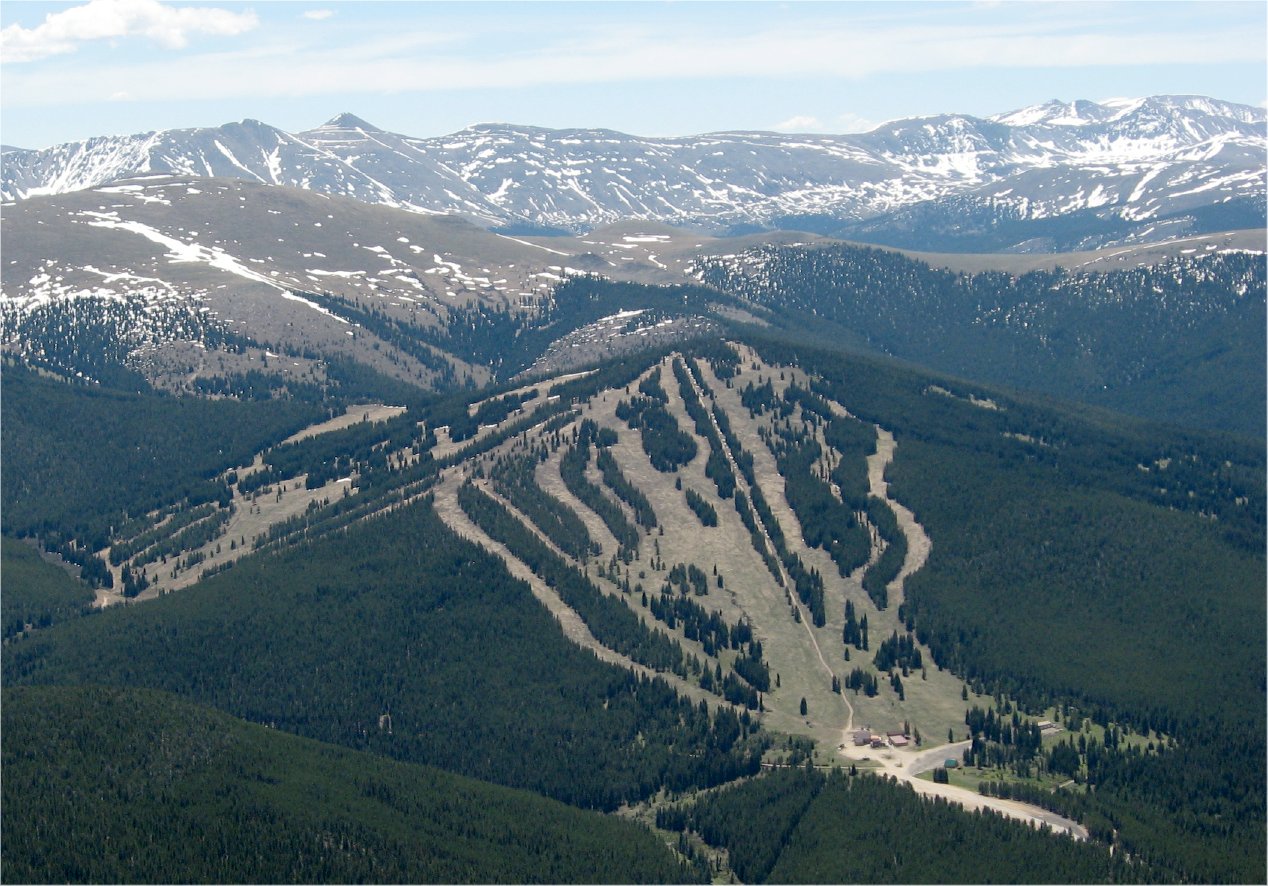
An aerial view shows Ski Cooper’s terrain layout near Leadville. This is an off-season view, not a current snow report. Photo: The original uploader was Sculptorjones at English Wikipedia.. Public domain. Original image. Resized and converted to WebP; original license retained.
Ski Cooper's smaller natural-snow mountain is a different Colorado product from Vail's developed destination experience. A Leadville purchase should work because you want that town and skiing, rather than because its price is below an expensive national anchor.

Arizona Snowbowl’s Grand Canyon Express area during its December 2016 opening celebration. This historical photograph illustrates the setting, not the resort’s current lift inventory. Photo: Coconino National Forest. CC0. Original image. Resized and converted to WebP; original license retained.
Flagstaff is included to make the boundary clear: Arizona has substantial downhill skiing, but that fact does not establish cheap housing. Snowbowl's current operator media information describes 777 acres and 2,800 lift-served vertical feet. Storm variability, sunny periods, wind and snowmaking affect the practical season. Choose Flagstaff for its whole setting if the budget fits; do not assume a Southwest location makes it the affordable winner.
Is Wisconsin or Michigan skiing as good as Kellogg or the East Coast?
It depends on what “good” means, but the terrain differences are real. Price should not obscure them.
| Skiing experience | Where the Midwest can work well | Where substantial western or northeastern mountains usually have an advantage |
|---|---|---|
| Learning and family repetition | Short laps, local lessons, familiar terrain and often convenient night sessions | More terrain as skills advance, with resort-specific differences in programs and cost |
| Long sustained runs | Usually limited by modest vertical | Silver Mountain, Discovery, Wildcat, Gore and other larger mountains provide longer descents |
| Powder and trees | Lake-effect belts can be excellent; Bohemia is a notable expert niche | More extensive alpine and tree terrain at many larger western mountains |
| Groomer weekends | Snowmaking and cold temperatures can support a satisfying local routine | Larger networks provide more variety for a long vacation |
| Easy frequent use | A nearby hill can be better than an infrequent expensive trip | A larger mountain wins only if the buyer can reach and afford to use it |
Michigan is not one snow climate. The Upper Peninsula and lake-effect belts differ from southern Lower Peninsula hills. Wisconsin also includes areas with different natural snowfall and terrain. Grouping both states together as uniformly inferior misses the actual options.
Silver Mountain's roughly 2,200-foot vertical and broad mountain terrain are materially different from the modest vertical at most Midwest hills. A skier who values long descents and extensive exploration will notice the difference every day. A beginner family mainly repeating a few groomers may notice convenience and ticket expense more.
The East Coast also should not be treated as a single product. Wildcat, Gore, Whiteface, Jay, Killington and Saddleback provide substantial mountain skiing. A small southern New England hill is a different experience. Natural snow, wind and thaw-freeze weather can vary widely across them.
Snowmaking changes the value discussion. A hill receiving less natural snow may maintain a useful groomed product through cold periods. A natural-snow mountain receiving more annual snowfall may still have a poor early season or a warm holiday week. Snowmaking coverage supports specific trails; it does not convert every tree line into reliable skiing.
Annual snowfall is also an imperfect comparison. Resort averages may cover different periods, elevations and measurement methods. Marketing averages and recent independent seasonal records can disagree. This guide labels reported figures rather than pretending they are a uniform scientific ranking.
Season length has the same limitation. A resort's usual November opening or April closing is an expectation, not a commitment that every lift and run operates for five months. Small community hills may open only on selected days and require sufficient natural cover. Ask how many days the terrain you want was usable, not merely how many days something at the mountain was open.
For a fixed-date vacation, inspect historical conditions around those dates and the current forecast. For a home purchase, inspect several recent seasons, including disappointing ones. A property near a ski hill has to make sense through ordinary and poor winters as well as exceptional powder years.
Why a lower-priced ski town might stay lower-priced
It is tempting to see skiing plus inexpensive housing and conclude that the town must be waiting for a boom.
Sometimes an overlooked place attracts more buyers. Sometimes its prices reflect conditions that persist: a limited employment base, fewer services, older buildings, a longer journey from major population centers or a recreation experience that appeals to a narrower group.
An affordable town can be a wonderful place to own even if it never becomes a famous destination. The benefit may be more skiing, a smaller payment and a lifestyle you enjoy now.
That is a stronger basis for choosing a home than assuming someone else will eventually pay a premium for it.
What does it really cost to own a ski home?
The purchase price is the first comparison. The annual ownership budget is the more useful one.
The Consumer Financial Protection Bureau explains that housing costs extend beyond principal and interest to taxes, insurance, possible mortgage insurance and association fees. Maintenance and utilities also belong in the affordability calculation.
For a ski-area home, build a worksheet around the actual property:
| Expense | What to establish before buying |
|---|---|
| Mortgage | Your loan amount, rate, term and occupancy classification |
| Property taxes | A parcel-specific estimate and any change after purchase |
| Insurance | A quote for the intended use and property's characteristics |
| HOA or condominium dues | Current charges, coverage and assessment exposure |
| Heating and utilities | Actual bills where available, not a general town estimate |
| Maintenance | Building-specific near-term work and an ongoing reserve |
| Winter access | Snow removal, driveway maintenance and road arrangements |
| Skiing | Passes or tickets, lessons, rentals and equipment for the household |
| Travel | Fuel, flights, vehicle wear and time required to use the home |
| Remote ownership | Management, inspections and emergency response when absent |
A simple mortgage comparison
The following illustration assumes 20% down, a 30-year fixed loan and a hypothetical 6.5% interest rate. It is a calculation example, not a current rate quote or loan offer. Payments are rounded and include principal and interest only.
| Purchase price | Down payment | Loan amount | Monthly principal and interest |
|---|---|---|---|
| $200,000 | $40,000 | $160,000 | About $1,011 |
| $300,000 | $60,000 | $240,000 | About $1,517 |
| $400,000 | $80,000 | $320,000 | About $2,023 |
| $500,000 | $100,000 | $400,000 | About $2,528 |
The difference between a $300,000 and $500,000 purchase is about $1,011 a month in this example, before differences in taxes, insurance and other costs. That is meaningful. So is buying a lower-priced property that immediately requires a roof, heating system and structural repairs.
Primary home, second home or rental property?
The same town can make sense for one purpose and fail for another.
A primary home
Start with everyday life. Employment, healthcare, school arrangements where relevant, internet, shopping and travel routines will affect far more days than skiing does.
If your job is remote, confirm service at the actual address and understand your employer's location requirements. If you need local employment, investigate that first. A less expensive home does not solve an income problem.
A second home
Start with frequency of use. Calculate the actual door-to-door journey and ask how often you will make it in winter.
You also need a plan for a vacant house: heat, leaks, snow, power interruptions and someone who can respond locally. Convenience to the mountain cannot compensate for a home you rarely reach.
A rental property
Start with legal use and building rules, then evaluate revenue. Confirm zoning, permits, occupancy requirements, association restrictions and any resort-program obligations with the relevant authorities and documents.
Our vacation rental buying guide explains how to evaluate a property intended for rental use. Projected nightly revenue is not owner income. Include vacancy, management, cleaning, platform costs, utilities, insurance, repairs and the nights you reserve for yourself. Ski-season demand alone does not establish year-round performance.
A property can be a good personal purchase without being a strong rental business. Keep those two evaluations separate.
A practical buying process
First, define the lifestyle you are buying
Write down your maximum ownership budget, acceptable winter journey, preferred terrain, expected ski days and year-round needs. This prevents every attractive listing from changing the goal.
Second, narrow to a few towns
Choose places that fit your region and use pattern. National research is useful for finding possibilities; the serious property search needs a smaller field.
Third, visit during ordinary winter conditions
Stay in the town where you might buy. Ski your intended mountain. Drive the route when you would normally leave. Test grocery runs, internet, parking and the trip back after skiing.
A vacation at the resort tells you how the resort works. It does not necessarily tell you how owning a home in town will work.
Fourth, visit outside ski season
See whether you enjoy the place when skiing is unavailable. Pay attention to the activities you actually like, not the longest list of attractions in a visitor brochure.
Fifth, compare real properties
Separate detached homes, condominiums, manufactured homes, leased-land properties and vacant lots. Price each ownership structure honestly. Do not use a broad regional statistic as a substitute for comparable sales and inspections.
Sixth, build the property-specific annual budget
Get insurance quotes, tax estimates, building documents and repair estimates. For a condominium, review reserves, meeting records and assessments. For a remote property, establish access and utility arrangements.
Seventh, assess the purchase without a growth story
Ask whether you would still want the home if the town grows slowly, the proposed expansion never happens and resale takes longer than expected. If the answer is yes, the purchase has a foundation in use rather than speculation.
Choose a ski town for the life you will actually use
Start with a few candidates in a region you can reach and a terrain category you enjoy. Compare real homes, total annual ownership expenses and the ordinary winter journey. Then spend time in the town, not just at the resort.
A family learning to ski may get more value from a nearby community hill than from a larger mountain it visits once a year. A strong skier may happily accept an older town house to live near demanding terrain. Someone who needs city services may choose a longer ski drive rather than a small resort community.
The affordable choice is the one where those decisions work together. It does not need to become the next famous resort to be worthwhile.
Frequently asked questions about affordable ski towns
What is the cheapest ski town in America?
There is no defensible single winner without defining property type, home condition and distance to downhill skiing. Compare available homes and recent comparable sales in working-town markets such as Ironwood, Rumford and Berlin. This guide does not claim they form a verified national price ranking.
Where can you live near substantial western skiing without a luxury-resort address?
Start with Kellogg and Silver Mountain, Anaconda and Discovery, Pocatello and Pebble Creek, and Chewelah and 49 Degrees North. Each provides substantial mountain terrain, but their town settings, winter drives and property expenses differ.
Are there affordable ski towns in Washington?
Washington deserves several separate searches: Chewelah for 49 Degrees North, Wenatchee for Mission Ridge, Chelan for community skiing at Echo Valley, and Twisp or Winthrop for downhill skiing at Loup Loup. They offer different terrain and housing markets, so an inexpensive hill should not be used to label an entire town cheap.
Is Kellogg cheaper than the Sandpoint and Schweitzer area?
Matching local association snapshots show a $313,000 Shoshone County median versus $543,000 in Bonner County for year-to-date site-built single-family sales on less than two acres through September 2026. That supports a regional comparison, not a Kellogg city median or a Schweitzer-condo price. Compare actual properties serving each mountain.
Does Arizona have real downhill skiing?
Yes. Flagstaff has Arizona Snowbowl, and the White Mountains have Sunrise Park Resort. Snowbowl offers substantial mountain terrain; Flagstaff's housing still needs its own affordability comparison. Southwestern storm variability, snowmaking and elevation affect the ski experience.
Can Wisconsin or Michigan replace a western ski mountain?
For learning, local groomer laps and frequent family outings, a nearby Midwest hill may offer better practical value. Most have shorter descents than substantial western mountains. Lake-effect areas and Mount Bohemia provide notable natural-snow exceptions, but they do not reproduce every western terrain experience.
Are nonprofit or municipal ski hills worth considering?
Yes, especially for repeated family outings. Cottonwood Butte, Snowhaven, Loup Loup, Echo Valley, Titcomb and Black Mountain of Maine illustrate different local models. Compare terrain, lift type, lessons and operating days alongside ticket prices.
Can private skiing be relatively affordable?
Joinable regional clubs such as HoliMont, Ausblick and Hunt Hollow offer a different proposition from buying into a property-linked private mountain. Get a complete initiation-and-dues quote. Deer Mountain Village also requires land or home costs and carrying expenses; published development targets do not establish completed amenities.
Is a ski condo cheaper than a house?
It may have a lower asking price, but dues, assessments, insurance and rental restrictions can change the annual cost. Compare similar units and read the association documents. Our guide to buying a condo explains the property questions to investigate.
Sources, dates and how to read the comparisons
The guide is an editorial shortlist, not a census of ski areas or a verified national housing ranking. The 18 core profiles focus on useful ownership routes to downhill skiing: working towns, city bases and a specific resort-condo search. Community hills, private products and relative-value alternatives are labeled separately.
Housing examples retain their category, geography and reporting period. A regional median does not become a town price. A combined condo-and-house median does not become a detached-home median. Where a consistent price series has not been established, the profile does not invent one.
Housing sources:
- Coeur d'Alene Regional REALTORS' county snapshots: year-to-date September 2026 site-built single-family sales on less than two acres in Shoshone and Bonner counties, reported as of October 5.
- New Hampshire REALTORS/PrimeMLS August 2026 report: Coos County year-to-date single-family median through August, current as of September 5.
- Weber County and Cache County brokerage reports: WFRMLS single-family closed sales over the year ending September 30, 2026.
- Greater Pocatello Association March 2026 snapshot, published by Pioneer Title: the association-market combined single-family and townhome/condo category.
- Maine Listings' May 2026 housing report: Oxford County existing single-family median for March through May.
- Park City Board of REALTORS' Q2 2026 report, Aspen's local midyear transaction report and Jackson Hole's Q2 snapshot: the expensive-market categories and dates shown in the opening table.
Terrain and reported snowfall come from the linked operators and ski organizations. Their snowfall averages may use different periods and measurement sites. They are not a normalized climate ranking or a guarantee for a visit. Operating schedules, snowmaking coverage and actual open terrain must be read separately.
The February 2027 accommodation examples are individual owner-advertised RedWeek asking prices, not market-wide averages or completed bookings. Other trip-budget figures are explicitly hypothetical. No matched-date lodging quote was established for every town.
Private fees retain their source seasons. Planned amenities are not described as completed. Historical photographs have dates and credits; they illustrate setting rather than current operations. The mortgage illustration assumes 20% down, 360 payments and a hypothetical 6.5% rate, excluding other ownership costs.
Compare actual North Idaho buying options
Darin Persinger works with buyers and sellers in Washington and Idaho through Persinger Group. The Silver Valley-versus-Schweitzer comparison is a starting point for a local property search. Explore North Idaho homes and Sandpoint real estate to compare the actual property with the skiing lifestyle you want.
:format(webp):quality(80)/u.realgeeks.media/katherinecannon/Check_your_home_value.png)
:format(webp):quality(80)/u.realgeeks.media/katherinecannon/Have_a_real_estate_conversation.png)
_8.jpg)


.jpg)